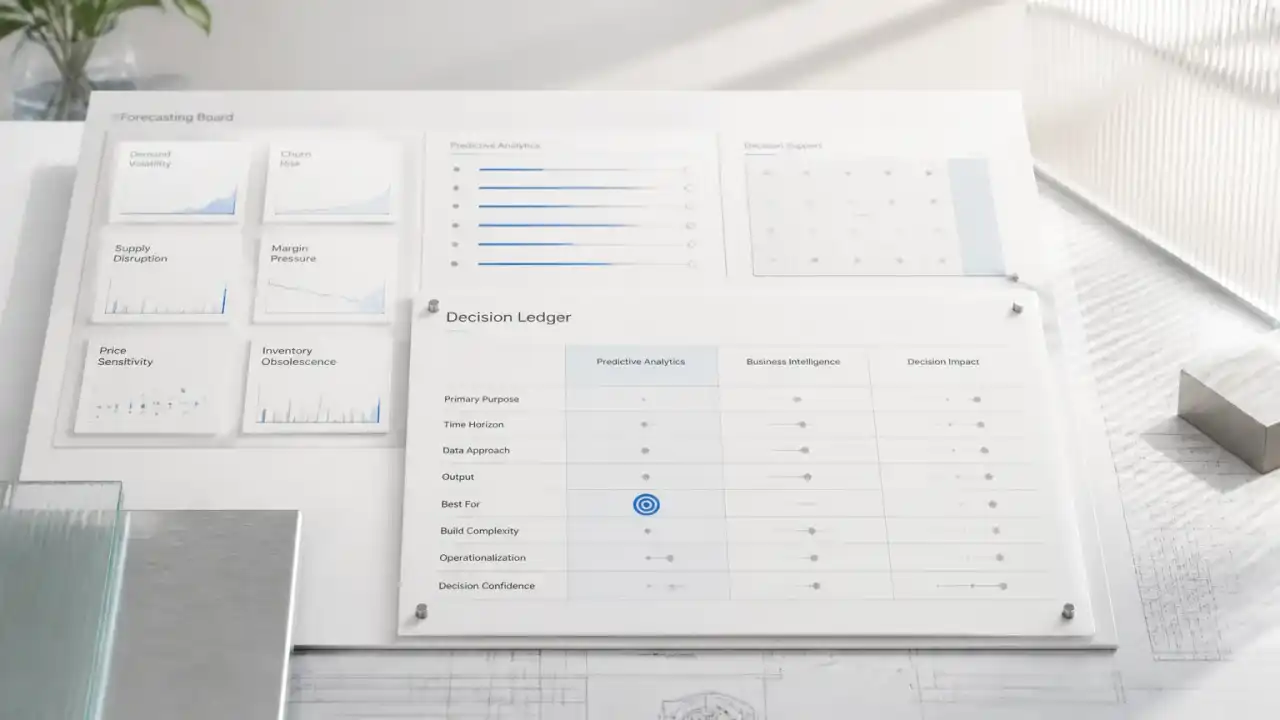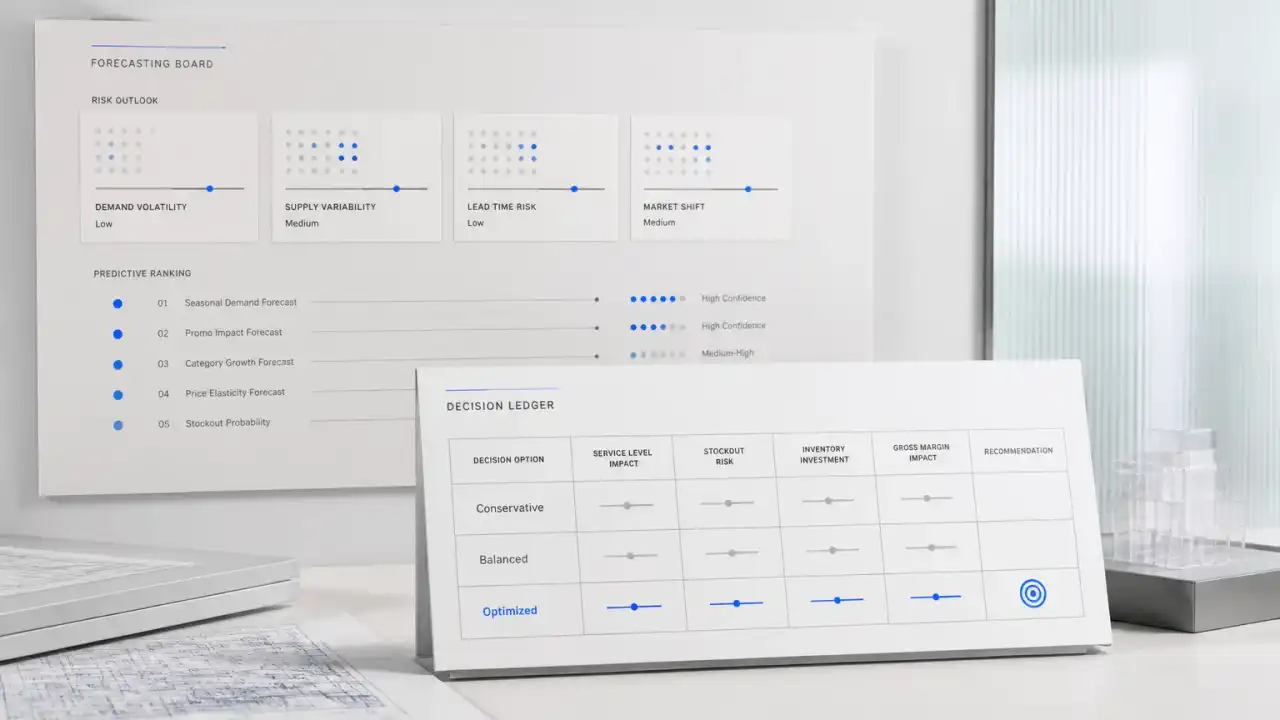
A new language model does not automatically make a forecast more accurate. But it can change the cost and quality of the work around a forecast: collecting context, explaining a variance, and routing an exception to someone who can act.
Anthropic announced Claude Sonnet 5.5 on September 28, 2026 (announcement). For predictive analytics companies and teams buying forecasting systems, the useful question is not whether the model is "better" in general. It is whether this release improves a specific, measurable part of your decision workflow without weakening forecast controls.
Treat it as a reason to run a controlled evaluation, not a reason to replace a forecasting model or rebuild a data platform. The best first test is often the review layer that turns a forecast into an approved business action.
When this needs an AI build
Move from research to an implementation conversation when analysts or operators repeatedly spend time assembling the same evidence for decisions. Examples include explaining why a sales forecast changed, investigating an inventory exception, or preparing a renewal-risk review from CRM notes and account history.
A build is more likely to pay off when the workflow has repeatable inputs, a defined reviewer, and a visible cost of delay or manual effort. A sales operations team, for instance, may want an assistant to collect changes in deal stage, recent activity, and forecast assumptions, then prepare a concise exception brief for a manager.
Do not start with "let the model forecast." Start with the decision that follows the forecast. If no one can say what action a changed prediction should trigger, a new model layer is unlikely to solve the underlying problem.
What changed for forecast buyers
Anthropic describes Sonnet 5.5 as suited to well-scoped document and spreadsheet work, with adjustable effort. That makes assembling a review brief a reasonable task to evaluate. The launch does not establish that the model improves a company's forecasting accuracy.
That distinction matters because forecasting and forecast communication are different jobs. A statistical or machine-learning forecast estimates what may happen from structured historical data and chosen assumptions. A language model can help people work with surrounding information, such as notes, explanations, and follow-up tasks. It should not be treated as a substitute for a validated forecasting method simply because it can produce a confident-sounding explanation.
For a buyer, the practical change is an evaluation opportunity. Test whether the new model handles your real review tasks more reliably, clearly, or economically than the version or process you use now. Keep forecast accuracy, review effort, and decision quality as separate measures. A polished explanation is not proof of a better prediction.
Forecast review workflow: from signal to approval
Consider a weekly inventory exception review. The forecasting system flags an item whose projected demand differs from the current plan. Today, an analyst may search several systems, interpret the signal, and write a summary before an operations lead decides whether to change the order.
A bounded AI workflow could work like this:
- Inputs: The system receives the approved forecast output, relevant inventory and sales records, the current planning assumptions, and authorized notes about known events.
- Context gathering: It retrieves only records the user is permitted to see and labels the evidence behind each point. Missing or conflicting information remains visible rather than being silently filled in.
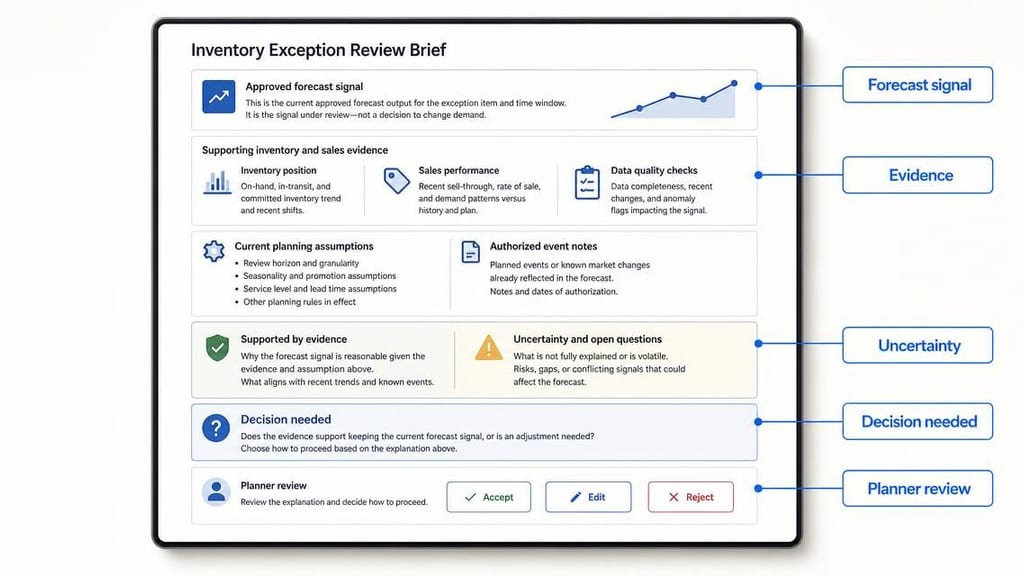
- Draft analysis: The model prepares a short exception brief: what changed, which evidence supports the explanation, what remains uncertain, and what decision is needed.
- Human approval: The inventory planner reviews the evidence and accepts, edits, or rejects the proposed explanation. A material order change still follows the company's existing approval path.
- Fallback and outcome: If the supporting records are incomplete, the workflow routes the case to manual review. If approved, it records the decision and rationale so the next review has a usable audit trail.
The outcome is not "AI makes the order." It is less time spent assembling context, more consistent exception reviews, and a clearer handoff from forecast to accountable decision-maker.
The Inventory Exception Review Brief
The same pattern can support sales forecasting. A model can gather CRM changes and prepare a manager's review packet, while the forecast remains calculated by the existing forecasting system and the manager retains responsibility for the call.
Build path: test the review task, not the headline
A useful evaluation starts with a narrow question: does the model reduce effort or improve the quality of a real review without increasing unacceptable errors?
Choose one workflow and one decision. Do not test "forecasting" as a broad category. Pick an action such as reviewing a late-stage deal, investigating a demand exception, or escalating a renewal account. Record who makes the decision and what evidence they need.
Capture a baseline. Measure how long the task takes, how often reviewers request corrections, and how frequently the final decision changes after further investigation. Keep these measures simple enough to collect before the pilot begins.
Assemble representative cases. Include ordinary cases and the difficult ones: incomplete records, conflicting notes, unusual seasonal patterns, or exceptions where the correct action is to wait. A workflow that performs only on tidy examples is not ready for business use.
Compare the model against the current process. Use the same input cases and review criteria. Check whether the assistant cites the correct records, distinguishes evidence from inference, identifies uncertainty, and produces a useful handoff. Also compare against the existing model or a simpler automation where possible.
Set approval rules before deployment. Define which outputs can be drafted automatically, which require review, and which should never trigger an action without an authorized person. Keep a route back to the existing manual process when data is missing or the system cannot support its recommendation.
Anthropic's announcement of embedded evaluation work with Accenture is a useful reminder that evaluation belongs inside implementation, not as a last-minute acceptance test. That partnership covers evaluation and safeguard assessment, not certification of a forecasting workflow. Our implementation recommendation is to agree on task-specific pass criteria before a pilot starts.
Build path: keep historical evidence historical
A retrospective test can look convincing while giving the assistant information that the original reviewer could not have known. Consider a hypothetical inventory review dated September 1. If the test supplies a revised sales record entered on September 15, the explanation benefits from knowledge unavailable when the purchasing decision was made. That is an evaluation failure even if every citation points to a real record.
Freeze each case at its decision time. Keep the forecast version, data extract, notes, and revision history that were actually available then. Evaluate the review packet against that snapshot. A later investigation can establish the eventual outcome, but it belongs in the scoring material rather than in the assistant's input.
For the underlying forecasting model, scikit-learn's TimeSeriesSplit documentation explains why ordinary splits can train on future observations and evaluate on the past. Chronological folds address that specific problem. They do not establish that feature preparation, revised records, or an explanation model are free of future information.
Review both layers independently. The forecasting team checks its time-aware holdouts and feature pipeline. The workflow team checks whether the assistant used only the evidence available to the reviewer. Report forecast error separately from unsupported statements, review corrections, and time spent assembling context.
The operating details that decide whether it works
Separate forecast generation from forecast explanation. Store the forecast output and its assumptions as controlled inputs. Let the assistant explain or organize them, but do not let a free-form response overwrite the source prediction.
Make evidence inspectable. A reviewer should be able to open the underlying record behind an important statement. If an explanation cannot be traced to available inputs, label it as a hypothesis or leave it out. This lowers the chance that a plausible narrative becomes accepted as fact.
Treat permissions as part of the workflow. A sales manager, planner, and account executive may not have equal access to customer or financial information. The assistant should inherit the intended access boundaries rather than pooling data for convenience.
Record decisions, not just prompts. Keep the source inputs, output version, reviewer edits, approval, and final action in a usable record. That helps teams diagnose mistakes and understand whether the tool is changing the decision or merely changing its presentation.
Measure review quality as well as speed. Faster drafting is useful only if reviewers can still spot unsupported claims and exceptions. Track correction rates and escalation patterns alongside time saved. A reduction in drafting time that creates more downstream rework is not a successful deployment.
These controls are especially important when a summary influences inventory purchases, staffing, customer outreach, or revenue planning. A language model can help prepare evidence; it should not conceal uncertainty that a decision-maker needs to see.
Risks and trade-offs: when to wait
Do not automate a review process whose inputs are unreliable or whose decision rights are unclear. If teams dispute the source of truth, the model may simply assemble contradictory records faster. Fix data ownership and review responsibility first.
Wait if decisions are rare, low-cost, and already quick to make. A custom workflow has ongoing costs: integration, access management, evaluation, user support, and changes when upstream systems or policies shift. A one-off prompt or existing reporting tool may be enough.
Be careful with explanations that sound more certain than the underlying signal. Forecasts carry uncertainty; the generated text should preserve it. Require the workflow to distinguish observed facts, model-generated interpretations, and missing evidence.
Also avoid expanding a successful draft assistant into automatic action without a separate evaluation. Drafting a review memo and changing an order are different risk levels. Each needs its own approval and fallback rules.
Compare candidates on the task, cost, latency, controls, and maintenance requirements that matter to your workflow. Replacing the explanation layer should remain reversible until reviewers consistently accept its evidence and uncertainty handling.
What Quellix would build
For a forecasting team, Quellix would start with a decision map: which forecast signals prompt review, what evidence a reviewer needs, and which outcomes require approval. The primary service context is AI predictive analytics and recommendation systems, with the implementation focused on the handoff between prediction and action, rather than an assumed replacement for the forecasting engine.
A first release might connect one forecast output to selected business records, prepare a review brief, expose evidence links, and route uncertain cases to a human queue. We would define the evaluation set and reviewer rubric before enabling the workflow, then compare the pilot with the current process.
The practical next step is to bring one recurring forecast review, a sample of its inputs, and the person accountable for the decision. That is enough to assess whether an AI layer is justified, what it should be allowed to do, and what should remain manual.
FAQ
Can Sonnet 5.5 replace the forecasting model?
The release announcement does not establish forecasting accuracy for your data. Evaluate any forecasting method on a separate, time-aware holdout. A review assistant can organize context while the approved forecasting engine remains responsible for the prediction.
What is the first useful workflow to test?
Choose one recurring exception review with known inputs and an accountable planner. Test whether the assistant assembles the right evidence, exposes uncertainty, and prepares a review packet that requires fewer corrections.
How do we prevent hindsight from improving the test artificially?
Freeze the records and notes at the original decision time. Keep later outcomes in the scoring material, and check revised records and feature preparation separately from the chronological split.
Should an accepted explanation automatically change an order?
No. Accepting the explanation and approving a purchasing change are separate decisions. Route material changes through the existing authorization process and record the exact action that was approved.
Related Reading
- Predictive Analytics vs BI: Choosing the Right Build helps distinguish decision-support needs from reporting needs.
- AI Demand Forecasting for Inventory Decisions covers the forecasting use case that often sits upstream of review and approval.