Personalization Engine: Building Signal-to-Action Systems
A B2B personalization engine must do more than predict what someone may click. It must recommend an eligible, useful, and timely action within operational constraints.
That distinction shapes the entire personalization engine implementation. A technically relevant recommendation can still be commercially wrong. It might conflict with a contract, expose restricted information, or interrupt a sensitive account conversation.
Quellix uses a Signal-to-Action model for these systems. It converts customer signals into ranked interventions, then applies business rules and approval controls before delivery.
When this needs an AI build
An AI build makes sense when teams repeatedly choose among many possible actions. The decision should also depend on patterns that static rules cannot express efficiently.
Common examples include ranking product guidance, prioritizing customer-success outreach, selecting an offer, and ordering sales opportunities. Each case has many candidates, changing context, and a measurable response.
A rules-only workflow is usually sufficient when there are few options or infrequent decisions. It is also preferable when policy dictates one unambiguous action.
Use this buyer-fit matrix before selecting an architecture:
- Few stable choices: Rules are a strong fit; AI-assisted ranking is usually unnecessary; a full personalization engine is a poor fit.
- Many candidates with contextual differences: Rules have limited fit; AI-assisted ranking and a full personalization engine are both strong fits.
- Sparse historical outcomes: Rules provide a strong starting point; constrained AI-assisted ranking may be possible; a full personalization engine is premature.
- Frequent decisions with measurable feedback: Rules have limited scalability; AI-assisted ranking and a full personalization engine are strong fits.
- High-impact errors: Use strict rules, add approval points to AI-assisted ranking, and require policy gates plus fallback paths for a full engine.
- Real-time context changes ranking: Rules are difficult to maintain; AI-assisted ranking and a full personalization engine are strong fits.
This decision should not depend on a universal user-count threshold. Data usefulness varies by event quality, outcome frequency, product design, and segment diversity.
For planning, a team might set an illustrative gate such as three months of reliable events and several hundred labeled outcomes. That is a hypothesis to validate, not an industry benchmark.
The Signal-to-Action model
A signal is a measurable change that may affect a decision. Examples include declining feature use, a new support issue, an approaching renewal, or a role change.
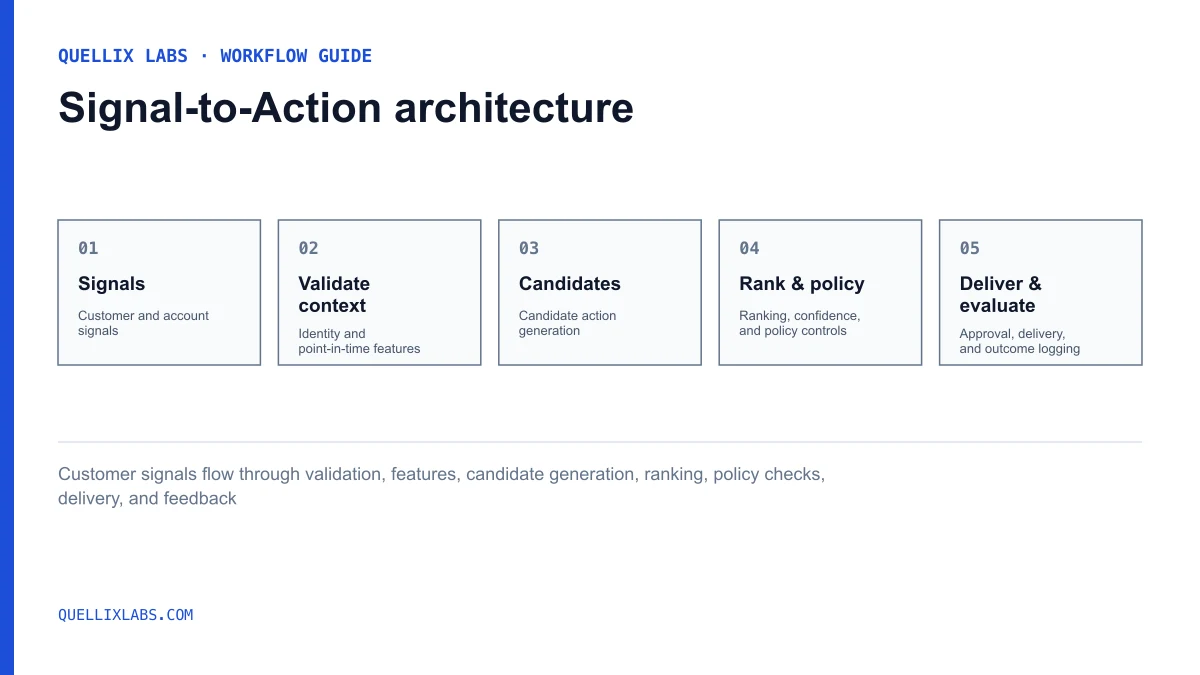
Signal-to-Action architecture
 Open the Pinterest-ready portrait graphic
An action is an intervention the business can execute. It could be a product prompt, training recommendation, account review, offer, or ranked task for a human operator.
The model between them has four responsibilities:
- Determine whether the signal is valid and timely.
- Generate actions that could address the observed condition.
- Rank those actions against the current context.
- enforce eligibility, policy, and delivery constraints.
This architecture separates prediction from permission. The model estimates relevance, while deterministic controls decide whether an action may proceed.
That separation is essential in B2B environments. Customer tier, geography, contract terms, inventory, and account ownership can all change what is permissible.
Why generic B2B recommendations fail
They confuse activity with intent
A user may inspect an advanced feature because a workflow failed. Another user may be evaluating an expansion. The events can look similar while requiring different responses.
The engine therefore needs sequence, role, account, and product context. A single click rarely provides enough evidence for a high-confidence intervention.
They learn from thin or biased feedback
B2B products often contain specialized roles and long decision cycles. Outcome labels may arrive well after the original recommendation.
The system must preserve the historical state used for each prediction. Otherwise, later information can leak into training data and produce misleading offline results.
They optimize the wrong proxy
Clicks are easy to measure, but they may not represent customer value. A renewal workflow may care more about issue resolution, retained usage, or an accepted success plan.
Define the business outcome before selecting the model. Then track intermediate behavior without treating every interaction as success.
They cannot explain suppression
Operators need to know why an action appeared, disappeared, or required approval. A score alone is not enough.
Store the leading signals, policy results, model version, and delivery decision. This record supports investigation without presenting the score as a causal explanation.
Technical build path for personalization engine implementation
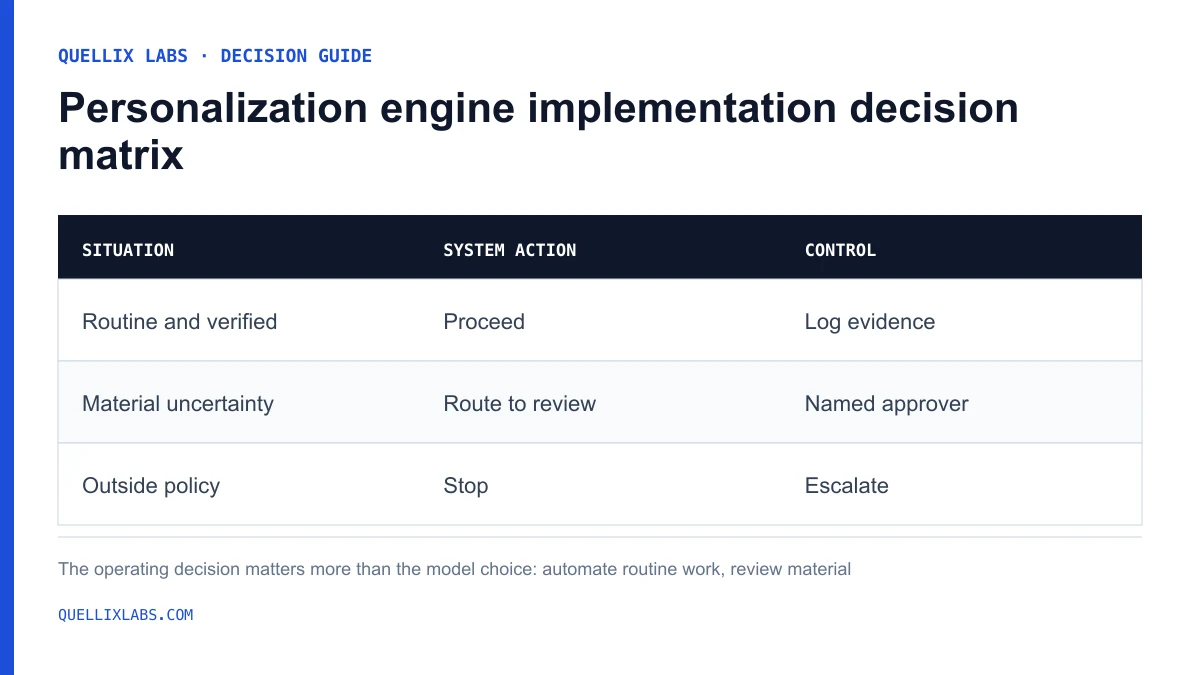
personalization engine implementation decision matrix
Read the data in this graphic
| Situation | System action | Control |
|---|---|---|
| Routine and verified | Proceed | Log evidence |
| Material uncertainty | Route to review | Named approver |
| Outside policy | Stop | Escalate |
1. Define one decision and one owner
Start with a narrow decision such as selecting the next customer-success action. Name the team accountable for the outcome and the team responsible for system operation.
Document candidates, exclusions, delivery channels, and escalation rules. This prevents the first model from becoming an undefined enterprise prediction layer.
2. Create an event and identity contract
Specify each event name, required properties, timestamp behavior, retention policy, and owning system. Connect user activity to the correct account without collapsing distinct roles.
Reject or quarantine malformed events. Silent schema drift can alter rankings while leaving the service technically available.
3. Build point-in-time features
Features should represent what was known when the decision occurred. Useful groups may include product adoption, service history, contract timing, role, and previous interventions.
Keep sensitive or policy-restricted fields outside the ranking layer unless there is a documented basis for their use. Access controls should apply to features as well as outputs.
4. Generate eligible candidates
Candidate generation narrows the action space before ranking. It can combine catalog retrieval, rules, similarity search, and manually curated playbooks.
Large production systems commonly separate candidate retrieval from ranking. LinkedIn describes a multi-stage recommendation architecture for People You May Know, while eBay describes using vector search within its recommendation work (LinkedIn Engineering; Google Cloud and eBay).
The B2B version does not need their scale. It benefits from the same separation of concerns.
5. Rank with a controlled baseline
Begin with an interpretable rules or scoring baseline. Compare each model against that baseline rather than assuming machine learning is better.
Managed platforms can shorten experimentation and deployment work. AWS outlines an automated workflow for preparing data, creating solutions, deploying recommenders, and testing Amazon Personalize implementations (Amazon Web Services).
More complex representation learning may become relevant when one platform contains many recommendation surfaces. Netflix describes a foundation-model approach to personalized recommendation across its environment (Netflix Technology Blog).
Complexity should follow validated need. It should not be the starting requirement.
6. Apply business and policy gates
Run deterministic checks after ranking and before delivery. Typical checks cover entitlement, account status, channel permission, frequency caps, ownership, and active suppressions.
A fallback must exist for every blocked or unavailable path. The system might show a neutral action, route the case to review, or make no recommendation.
7. Deliver at the correct latency
Not every recommendation needs real-time inference. A nightly customer-success queue may be enough, while an in-product surface may require current session context.
AWS provides an implementation example for real-time personalized recommendations using event updates and an inference endpoint (Amazon Web Services). Choose this pattern only when fresh context can change the action.
Uber's out-of-app recommendation system also illustrates how candidate selection, ranking, and channel delivery form one operational workflow rather than an isolated model (Uber Engineering).
8. Log decisions and outcomes
Record the candidates considered, selected action, rank, model version, policy results, and delivery status. Capture whether the user or operator accepted, edited, ignored, or rejected the recommendation.
Do not interpret silence automatically. A recommendation may be unseen, unavailable, or displaced by an offline conversation.
Example workflow: SaaS renewal risk triage
Consider a hypothetical B2B SaaS operator that wants to reduce unexpected renewal risk. The values below illustrate workflow design and are not observed benchmarks.
Step 1: Collect signals. The pipeline receives product events, unresolved support themes, account ownership, contract dates, and prior interventions.
Step 2: Validate context. The system checks event freshness, account identity, active contracts, and missing fields. Invalid records move to a review queue.
Step 3: Estimate risk. A model detects an unusual decline in use of a critical reporting workflow. Renewal is also approaching within the company's chosen planning window.
Step 4: Generate candidates. Candidate actions include a technical review, training session, workflow guide, executive check-in, or no action.
Step 5: Rank actions. The engine predicts which eligible action is most appropriate for the current account state. A confidence band accompanies the ranking.
Step 6: Apply controls. The system removes an expansion offer because an unresolved severity-one issue is active. It selects a technical review instead.
Step 7: Request approval. A customer-success manager sees the signals, recommended action, and suppression reason. They may approve, modify, defer, or reject it.
Step 8: Capture the outcome. The system records the manager's choice and any later customer response. Evaluation separates recommendation quality from delivery failure.
A measurement plan could use the following structure:
- Data quality: Event completeness and freshness — detects unreliable inputs.
- Ranking quality: Relevant action within the reviewed top candidates — compares ranking approaches.
- Policy quality: Blocked ineligible recommendations — tests guardrails.
- Operator adoption: Approved, edited, deferred, or rejected — finds workflow friction.
- Delivery: Successfully presented or sent — separates ranking from channel failure.
- Business outcome: Resolved risk or retained product use — evaluates the intended result.
Risks and limits
Cold start and limited outcomes
A new product may lack enough behavior and outcomes to support reliable learning. Start with approved playbooks, content rules, and explicit operator feedback.
A model can be introduced after the workflow produces usable labels. Until then, rules provide both a service and a baseline.
Fragmented customer state
Recommendations become unsafe when contracts, support status, permissions, and activity disagree. Identity resolution and source ownership should be addressed before automated delivery.
Do not label these failures as model hallucinations. They are usually data, integration, or policy failures and need different remedies.
Feedback loops
The engine observes responses only to actions it selected. Repeatedly favoring the same candidates can narrow future training data.
Use bounded exploration only where errors have low impact. Higher-risk actions should rely on reviewed experiments or offline evaluation.
Delayed and ambiguous labels
B2B outcomes may take weeks or months to appear. Several teams may also influence the result.
Avoid claiming that a recommendation caused an outcome without an appropriate experiment. Report ranking performance, operational adoption, and business movement separately.
Model drift and silent policy change
Products, packaging, customer behavior, and sales priorities change. A previously useful feature may become misleading.
Monitor input distributions, outcome rates, suppression rates, and operator overrides. Version policy changes alongside models so teams can locate the cause of a shift.
Excessive automation
An accurate recommendation can still damage a relationship when delivered at the wrong moment. Sensitive account actions need review, especially during incidents or negotiations.
Automation level should depend on impact and reversibility. Low-impact guidance can move faster than pricing, renewal, or contractual actions.
Decision framework
Ask five questions before funding AI recommendation engine development services:
- Is there one repeated decision with a named business owner?
- Are candidate actions and ineligible actions clearly defined?
- Can historical inputs be reconstructed at decision time?
- Is there an observable response or outcome?
- Can the organization safely handle a wrong recommendation?
A "no" does not always stop the initiative. It identifies the prerequisite work, which may be instrumentation, policy design, integration, or workflow ownership.
What Quellix would build
Quellix would begin with a technical review of one decision surface. We would map available signals, candidate actions, policy constraints, outcome labels, and delivery systems.
The first release would include an event contract, point-in-time feature pipeline, candidate service, ranking baseline, policy gateway, and decision log. It would also include an operator view when approval is required.
We would then run the new ranking beside the existing process. This shadow period would expose missing data, unstable rules, and operational disagreements before automated delivery.
After validation, we would introduce controlled activation and monitoring. Expansion to additional surfaces would reuse shared components without forcing every workflow into one model.
This implementation path sits within Quellix's predictive analytics and recommendation systems service. The immediate next step is a technical review of the target decision, available evidence, and acceptable risk.