Contract Review AI: Build Custom or Buy SaaS?
Manual contract review can create delays and inconsistent handoffs when legal teams must compare recurring terms across a growing queue. The actual error and delay rate depends on the contract mix, playbook quality, and review process, so it should be measured from the organization's own baseline.
Organizations are evaluating automated contract systems, but technology buyers still face the same practical decision: purchase an off-the-shelf Contract Lifecycle Management tool or build a custom contract-review pipeline around proprietary playbooks, integrations, and review controls.
This article outlines the strategic trade-offs, operational limits, and decision frameworks to help you choose the right path.
When this needs an AI build
While off-the-shelf software excels at standard legal tasks, certain business environments require a custom-built solution. You should consider building a custom contract review AI pipeline if your operations meet any of the following criteria:
- Proprietary Playbooks: Your legal team operates on highly specific, custom negotiation playbooks that generic SaaS tools cannot easily ingest or apply consistently.
- Complex Downstream Actions: An extracted contract term must trigger automated actions in external systems, such as updating a customer relationship management (CRM) platform, adjusting inventory databases, or initiating billing workflows.
- Strict Security and Compliance: Your industry demands localized data processing. For instance, you cannot send contract text to third-party APIs and instead require on-premise deployments or secure, VPC-contained models.
- Non-Standard Document Formats: Your agreements are highly unstructured, containing complex tables, hand-written amendments, or nested schedules that generic optical character recognition (OCR) systems misinterpret.
Conversely, if your volume is low or you primarily review standard non-disclosure agreements (NDAs) and standard software-as-a-service (SaaS) terms, buying an off-the-shelf tool is almost always the more cost-effective choice.
The Extraction-to-Review Pipeline Workflow
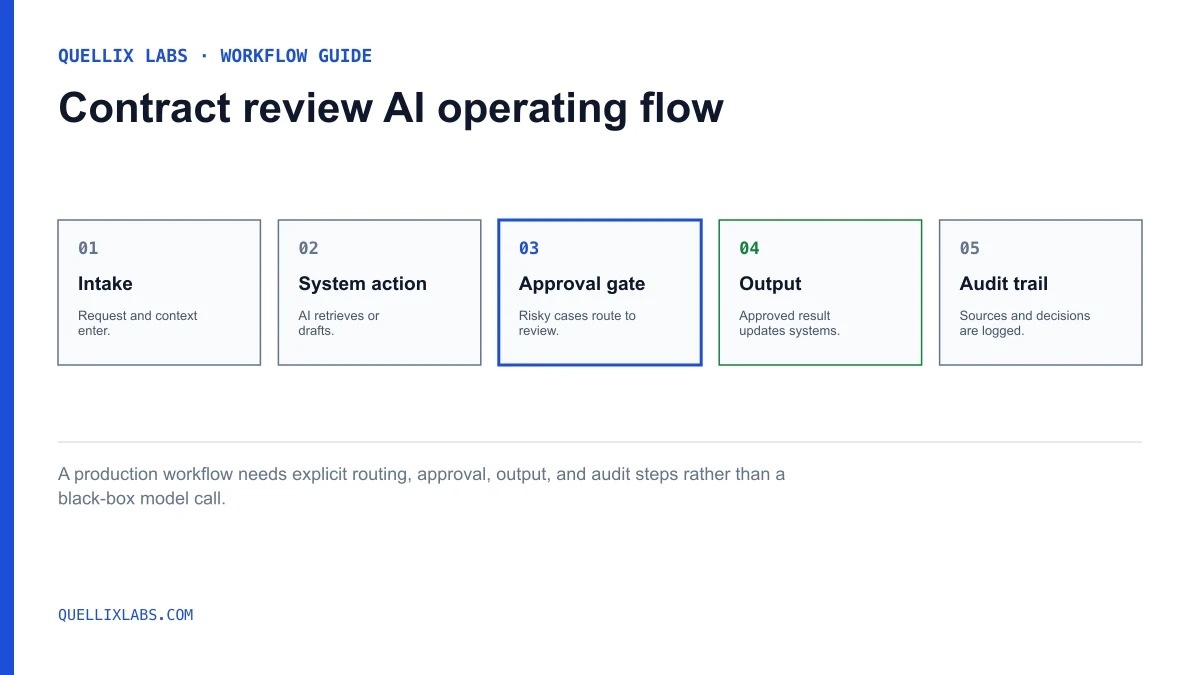
To understand what a custom build requires, consider how a high-performance extraction-to-review pipeline operates. A custom build does not just read text; it parses unstructured documents, extracts key fields, validates data, and presents structured information to human reviewers.
contract review AI operating flow
 Open the Pinterest-ready portrait graphic
Step 1: Document Intake and Parsing
When a contract is uploaded (such as a PDF or DOCX), the system parses the file. It uses specialized layout-aware parsers to preserve the visual structure of tables, signatures, and nested schedules, which are often lost in standard text extraction.
Step 2: Context Retrieval and Extraction
Using retrieval-augmented generation (RAG) and targeted parsing, the system locates specific clauses, such as limitation of liability, indemnification, or renewal terms. Unlike general-purpose models, a custom pipeline uses deterministic prompts or fine-tuned extraction models to ensure the same input always yields the same structured output.
Step 3: Rule Validation and Flagging
The extracted terms are evaluated against your pre-defined business rules. If a liability cap is missing, or if the renewal terms require more than 90 days of notice, the system automatically flags the clause as non-compliant.
Step 4: Human-in-the-Loop Approval
Because AI models can occasionally hallucinate or mischaracterize complex terms, the system routes the flagged contract to an internal legal or sales operations dashboard. The human reviewer can click on any flagged term to see the exact highlighted sentence in the original document, ensuring rapid verification.
Step 5: Downstream System Sync
Once the human reviewer approves the extraction, the structured data is pushed via API to your CRM, ERP, or billing system, eliminating manual data entry.
Custom Build vs. SaaS: Decision Framework
Choosing the right path requires balancing development costs against long-term operational efficiency. Use this framework to evaluate your options:
- **Primary Goal:** Off-the-Shelf SaaS: Standard NDA/Vendor review; Custom AI Build: Proprietary workflows & systems integration.
- **Setup Time:** Off-the-Shelf SaaS: Days to weeks; Custom AI Build: 2 to 4 months.
- **Data Privacy:** Off-the-Shelf SaaS: Shared cloud or multi-tenant; Custom AI Build: Fully isolated VPC or local models.
- **API Integration:** Off-the-Shelf SaaS: Limited to supported connectors; Custom AI Build: Unlimited, custom-designed endpoints.
- **Model Control:** Off-the-Shelf SaaS: Vendor-managed updates; Custom AI Build: Full control over model choice and tuning.
Risks, Limits, and When to Wait
Building custom AI systems involves notable engineering challenges. Technology buyers must be aware of several operational risks before committing to a build:
1. Hallucination and Legal Liability
Large language models do not understand law; they predict statistical word patterns. Even advanced legal-specific AI systems can produce incorrect interpretations or misgrounded citations. Unverified AI outputs can lead to serious compliance errors, unenforced terms, or financial liabilities. You must always keep a human professional in the review loop to validate critical outputs.
2. Document Layout Complexity
Contracts are rarely clean, linear text. Multi-column layouts, nested tables, scan artifacts, and hand-signed addenda can degrade extraction accuracy. If your engineering team does not have experience building robust OCR and layout-parsing pipelines, the system will struggle with complex documents.
3. High Initial Investment
Building a reliable, secure pipeline requires significant upfront engineering resources. If your organization processes fewer than several hundred complex, non-standard contracts per year, the return on investment (ROI) may not justify the development and maintenance costs. In these cases, utilizing off-the-shelf software or maintaining manual workflows is more practical.
What Quellix would build
At Quellix Labs, we design and deploy production-grade contract review systems tailored to your specific business operations. Under our AI Document Processing & Data Extraction service, we build bespoke "Extraction-to-Review Pipelines" that integrate directly with your existing software stack.
Our builds focus on auditability and precision. We construct custom user interfaces that display the original PDF side-by-side with extracted data fields. Every extracted value includes a direct, clickable anchor link back to the exact source sentence in the document, allowing your legal or operations team to verify accuracy in seconds. We also implement cost-aware routing and model fallbacks to keep operational costs low while maintaining high system reliability.
If you want to accelerate your contract workflows, eliminate manual data entry errors, and maintain full control over your legal data, we can help you evaluate and build a proprietary system.
Related Reading
- AI Contract Review: Building an Extraction Pipeline
- AI Contract Review Software: Build or Buy?
- Human-in-the-Loop AI: Scaling Support Without Risk
- Building AI Agents: What B2B Teams Should Automate