AI Contract Review: Building an Extraction Pipeline
Contracts are the lifeblood of business, yet they are often the biggest source of friction. In a typical B2B sales cycle, a deal can move from "verbal yes" to "legal review" in days, only to sit in a queue for weeks. This delay is not just an administrative nuisance. It is a revenue killer. When a contract waits for a human to manually verify every clause, deal momentum dies, and procurement costs climb.
Most leaders try to solve this by hiring more junior lawyers or buying a generic "AI Legal Assistant" that offers little more than a chat interface for PDFs. These approaches often fail because they lack a structured workflow. Chatting with a document is not the same as automating a process.
To drive real ROI, you need an Extraction-to-Review Pipeline. This is a dedicated AI system designed to turn unstructured legal text into actionable data, compare it against your internal playbooks, and flag only the specific risks that require human judgment.
The Problem: The High Cost of Manual Verification
Manual contract review is inherently unscalable. A senior legal counsel's time is best spent on high-value negotiation and strategic risk assessment. Instead, they can spend material time checking standard indemnity caps, governing-law clauses, and termination notices. Measure that share from the current review queue before estimating a business case.
This leads to three critical failures:
- The Bottleneck: Sales teams lose momentum while waiting for redlines.
- Inconsistency: Different reviewers may flag different issues based on their individual risk tolerance that day.
- Shadow Risk: Missing a single sub-clause in a 60-page Master Service Agreement (MSA) can expose a company to millions in liability.
By moving to an automated workflow, you shift the legal team's role from "first reader" to "final validator."
The Extraction-to-Review Pipeline Workflow
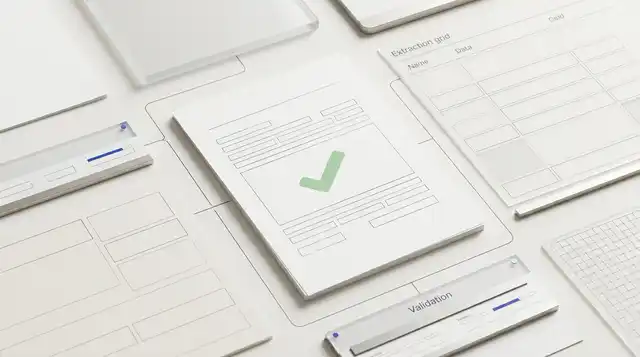
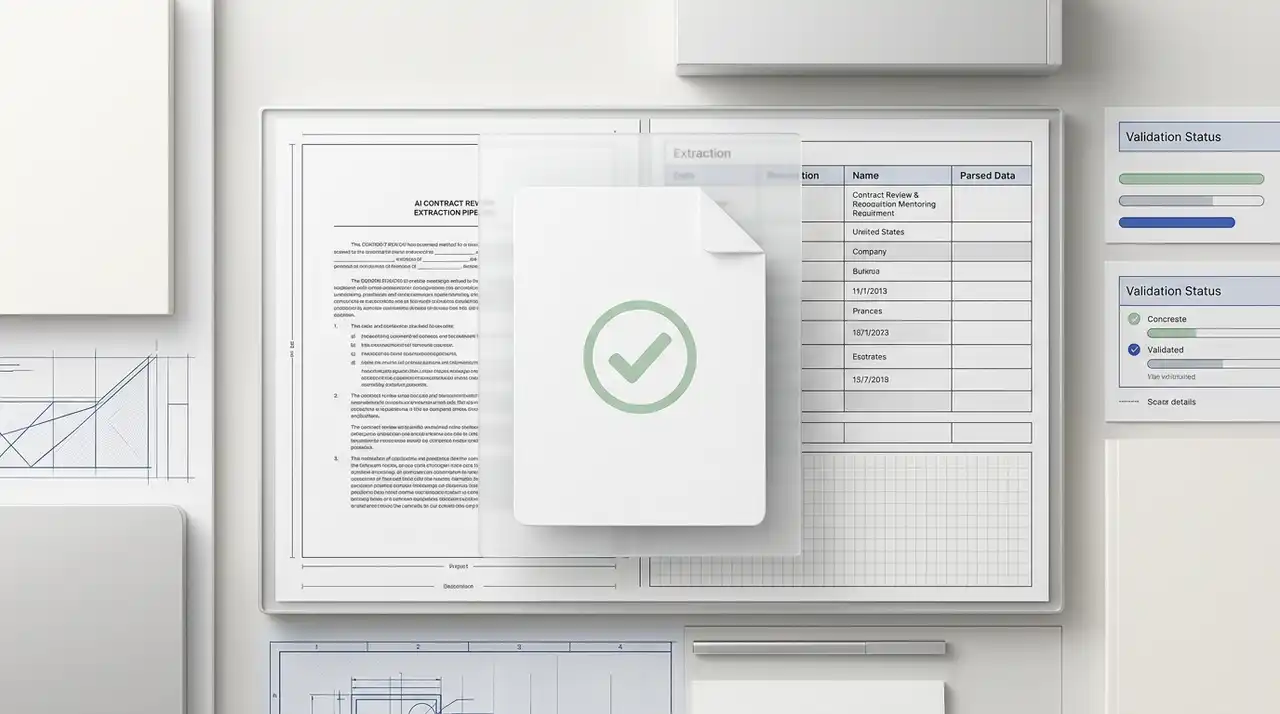
At Quellix Labs, we treat contract review as a structured data problem. We use our AI Document Processing & Data Extraction service to build pipelines that follow a specific, four-stage loop.
1. Ingestion and OCR
Every contract starts as a file-often a flattened PDF or a scanned image. The system uses advanced Optical Character Recognition (OCR) to convert pixels into text while preserving the visual hierarchy of the document (headers, footers, and tables). According to AWS Engineering standards, maintaining this layout is critical for understanding the context of specific clauses.
2. Structured Extraction
Instead of "summarizing" the contract, the AI extracts specific entities into a structured JSON format. It identifies:
- Parties: Who are the signers?
- Effective Dates: When does it start and end?
- Standard Clauses: Indemnity, Limitation of Liability, Confidentiality, and Force Majeure.
- Custom Obligations: Specific delivery milestones or payment terms.
3. The review-gated execution Loop
This is where the "operating loop" begins. The system does not just extract text; it reasons about it. It compares the extracted clauses against your company's "Gold Standard" playbook.
- Reason: The AI compares the "Limitation of Liability" clause to your required $1M cap.
- Act: If the clause matches, it marks it as "Compliant." If it says $10M, it generates a suggested redline based on your standard language.
- Verify: The system assigns a confidence score to its own action. If the language is highly non-standard or ambiguous, it triggers a mandatory human review.
4. Human-in-the-Loop (HITL) Approval
The final output is a dashboard for the legal team. They don't see a blank document; they see a list of flagged variances. They can approve the AI's suggested redline with one click or step in to handle complex negotiations.
Implementation: Building Your Legal Playbook
A successful build requires more than just a model; it requires a digitized playbook. You cannot automate what you cannot define. Before building the pipeline, we work with sales and legal leaders to define their "Standard Operating Procedures" for contracts.
Example Workflow: Incoming NDA Review
- Input: A vendor's standard Non-Disclosure Agreement (NDA).
- System Action: The AI extracts the "Term of Confidentiality." It sees "5 years."
- Reasoning: Your company policy requires a minimum of "3 years" but allows for "5 years" if certain other protections are present.
- Outcome: The AI marks the clause as "Acceptable" but adds a note to the metadata for the procurement officer.
This level of specificity is what separates a production-grade system from a experimental chatbot. As noted in Google Cloud's Document AI documentation, specialized processors for legal documents drastically reduce the error rates compared to general-purpose LLMs.
Risks, Limits, and When to Wait
AI contract review is powerful, but it is not a magic wand. There are specific scenarios where building an automated workflow might not be the right move yet.
The Context Window Trap
Very long documents (100+ pages) can sometimes exceed the "context window" of certain AI models, leading to missed clauses at the end of the document. We mitigate this by using a chunking and indexing strategy, but it adds complexity to the build.
Hallucination in Legal Citations
AI models can occasionally "hallucinate" or misinterpret legal citations (e.g., citing a non-existent section of the Delaware General Corporation Law). This is why the Verify step in our loop is non-negotiable. We never allow an AI to send a final redline to a counterparty without a human approval point. For more on this, see our guide on Designing Governance into AI Workflows: Approval Points and Fallback Paths.
When Not to Build
If your organization handles fewer than 10 contracts per month, or if every single contract is a bespoke, one-of-a-kind agreement (like a complex M&A deal), the cost of building and maintaining a custom pipeline will likely outweigh the manual labor savings. AI excels at high-volume, semi-structured documents like NDAs, MSAs, and Statements of Work (SOWs).
A Practical Build Path for Founders and Operators
If you are deciding whether to invest in this technology, follow this three-step decision framework:
- Audit Your Volume: Identify the document type that causes the most delays. For most B2B companies, this is the MSA or the security exhibit.
- Define Your "Redline Rules": Can you write down your requirements for these documents in a set of logical rules? (e.g., "If Indemnity > $1M, then flag for VP Finance"). If you can't define the rule, the AI can't follow it.
- Start with Extraction, Then Reasoning: Don't try to automate the whole negotiation on day one. Build a system that accurately extracts the data first. Once your team trusts the data, add the reasoning layer to suggest redlines.
By following this path, you ensure that the system provides value from the very first week. You aren't just buying a tool; you are building a durable asset that scales with your deal flow.
The Operating Standard: Reliability Over Speed
At Quellix Labs, we prioritize reliability. A fast system that misses a critical "Change of Control" clause is worse than no system at all. We align our builds with the NIST AI Risk Management Framework, ensuring that every extraction is traceable back to the source text. This "Cited Knowledge" approach ensures that when a lawyer asks, "Why did the AI flag this?", the system can point exactly to the sentence and the internal policy that triggered the alert.
This transparency builds the trust necessary for your legal team to actually use the system. Without trust, your AI build becomes expensive shelfware.
Next Steps for Technology Buyers
If your sales cycle is stalling in legal review, it is time to move beyond manual processing. A custom Extraction-to-Review Pipeline can shorten avoidable review handoffs and improve the consistency of risk triage. The effect on time-to-signature must be measured against your current contract mix and approval process.
Start by identifying one high-volume document type. Map out the standard redlines your team makes. Then, look for a partner who can build a pipeline that integrates directly into your existing CLM or CRM, rather than adding yet another siloed tool to your stack.