RAG Use Cases: Where Enterprise Retrieval Pays
Important answers often exist inside the business already. The problem is that employees cannot find, verify, or safely reuse them during live work.
Retrieval-augmented generation, or RAG, can close that gap. It retrieves relevant company information and gives that context to a language model before an answer is generated. The model can then work from organization-specific material without treating a static model memory as the source of truth.
The opportunity is not "chat with every document." It is a narrower business question: where would reliable retrieval remove delay, repeated research, or avoidable mistakes?
When this needs an AI build
Move from research to an implementation conversation when four conditions are present:
- A recurring decision depends on scattered knowledge. People repeatedly search policies, product documentation, contracts, case histories, or account records.
- The source material changes. Answers cannot be frozen into a static chatbot or manually maintained FAQ.
- The user must see evidence. Citations, document dates, and source ownership matter.
- Access is not universal. Results must respect department, account, region, role, or document permissions.
A RAG build is especially attractive when research time delays revenue or service. Examples include a support agent searching five systems, a salesperson preparing for a renewal, or a technician locating the correct repair procedure.
Do not begin with RAG when the source material is missing, contradictory, or rarely consulted. Retrieval cannot repair weak operating knowledge by itself.
Enterprise search architecture must account for more than a language model. Microsoft's enterprise search planning guidance highlights the importance of content sources, crawl planning, relevance, security, and search operations. Those concerns remain central when a generative answer is added.
What changes when retrieval works well
A strong implementation changes the point at which employees receive context. Instead of leaving a workflow to search several systems, they get relevant evidence inside the support desk, CRM, contract workspace, or field application.
The system should not merely produce fluent prose. It should:
- retrieve information the user is allowed to access;
- identify the source and its effective date;
- distinguish evidence from model-generated interpretation;
- decline when support is weak or conflicting;
- route sensitive decisions to a qualified reviewer;
- record which sources contributed to the response.
A search experience can also expose direct results, filters, and source previews. RAG should add useful synthesis rather than remove the buyer's ability to inspect evidence. Microsoft's overview of search architecture provides a useful reference for separating content collection, indexing, query processing, and result presentation.
The correct design is therefore the smallest retrieval loop that reliably supports the decision.
Top RAG use cases across industries
The strongest use cases combine repeated questions, valuable source material, and a clear boundary on what the system may decide.
| Industry or function | Knowledge retrieved | System output | Human boundary | Measure first |
|---|---|---|---|---|
| Customer support | Product manuals, policies, prior cases, account entitlements | Cited answer or response draft | Agent approves refunds, exceptions, and customer-facing commitments | Search time, escalation rate, answer acceptance |
| B2B sales | CRM notes, call transcripts, product material, contracts | Account brief, objection evidence, renewal summary | Seller approves outreach and commercial claims | Preparation time, CRM completeness, accepted recommendations |
| Legal and procurement | Clauses, playbooks, policies, executed agreements | Clause comparison and issue list | Counsel or contract owner decides risk and wording | Review time, missed deviations, unsupported flags |
| Manufacturing and field service | Manuals, service bulletins, parts data, maintenance history | Diagnostic guidance and cited procedure | Technician confirms safety-critical action | Time to locate procedure, repeat visit rate, citation usage |
| Financial services | Approved procedures, product rules, internal controls | Staff guidance and case evidence | Authorized employee makes regulated or customer-impacting decisions | Handling time, review exceptions, outdated-source rate |
| Healthcare operations | Administrative policies, scheduling rules, approved pathways | Operational guidance and document navigation | Qualified staff retain professional judgment | Search time, escalation quality, source freshness |
| Software and IT | Runbooks, architecture decisions, incident records, service catalogs | Troubleshooting steps and incident context | Engineer approves production changes | Time to relevant runbook, resolution time, failed suggestions |
| Multi-site operations | Standard operating procedures, training material, local rules | Role-specific instructions | Local owner approves exceptions | Repeated questions, onboarding time, policy adherence |
These are not eight versions of the same chatbot. Each needs different data connectors, metadata, permission rules, evaluation sets, and approval points.
Support: answer preparation, not unchecked resolution
Support is often a suitable starting point because questions repeat and outcomes are measurable. The system can retrieve product instructions, entitlement data, and similar resolved cases. It then drafts a response with citations.
The boundary matters. A support assistant may explain an approved return policy. It should not invent an exception, promise a refund, or expose another customer's case.
A practical first release stays in agent-assist mode. Measure whether agents accept the cited evidence and how often they materially rewrite the answer. Only narrow, proven question types should move toward automatic responses.
Sales: retrieve account truth before generating language
Sales RAG should reduce account research, not generate generic prospecting copy. Useful inputs include CRM activity, approved case studies, call notes, open support issues, and contract dates.
The output might be a renewal brief showing stakeholder changes, unresolved concerns, relevant product usage, and the source behind each point. The account owner approves any external message.
A non-obvious design choice is to keep absence visible. If no approved evidence supports an industry claim, the system should say so. Filling that gap with plausible language creates commercial and reputational risk.
Contracts: detect differences without pretending to give judgment
A contract workflow can retrieve the current clause playbook, compare language, and identify deviations. It can also link each issue to the approved fallback position.
This works best when clause types and document versions are labeled during ingestion. Whole-document similarity is often less useful than retrieving the relevant clause, policy section, or obligation.
The tool should prepare review, not replace counsel. Risk acceptance, interpretation, and negotiation language remain with authorized people.
Field service: retrieve by equipment context
A field technician rarely needs every document matching "pressure fault." They need instructions for a specific model, configuration, location, and maintenance state.
Metadata is therefore part of the product. Serial range, model, region, revision date, component, and safety classification can determine whether a passage is usable. This is one reason RAG quality depends as much on information structure as model choice.
Regulated operations: prove the retrieval path
In regulated operations, a polished answer is insufficient. Buyers need to know which approved source was retrieved, whether it was current, and why the user could access it.
Start with staff guidance and evidence navigation. Keep consequential decisions outside the model until evaluation and governance justify a narrower automation boundary.
Workflow and implementation architecture
A production RAG system has two connected paths: a knowledge path and a question path.
KNOWLEDGE PATH
Source systems → parsing → useful sections → metadata and permissions
               → search index → freshness and deletion checks

QUESTION PATH
User and role → query interpretation → permitted retrieval → ranking
              → answer with citations → confidence fallback → feedback log
Enterprise search documentation commonly separates data stores, indexing, retrieval, and search experiences. Google Cloud's custom search documentation and data store guidance are useful references for thinking about those boundaries.
A practical build path follows six steps.
1. Define the decision surface
Choose one user, one recurring question set, and one business outcome. "Search all company knowledge" is too broad for a useful first release.
Specify what the system may answer, what it must refuse, and what requires approval. This creates an evaluation boundary before vendors or models shape the project.
2. Map authoritative sources
List each source system, owner, update frequency, permission method, and deletion requirement. Decide which source wins when two documents conflict.
The first hard problem is often not retrieval. It is ownership of obsolete documents.
3. Create retrievable units
Split content around business meaning rather than arbitrary length alone. A contract clause, troubleshooting step, policy exception, or product limitation should remain understandable when retrieved separately.
Attach metadata that can filter results before generation. Useful fields include product, account, jurisdiction, version, audience, status, and effective date.
4. Enforce access during retrieval
Permission filtering should happen before restricted text reaches the model. Hiding a citation after generation is not equivalent.
Permission Filtering Before Generation
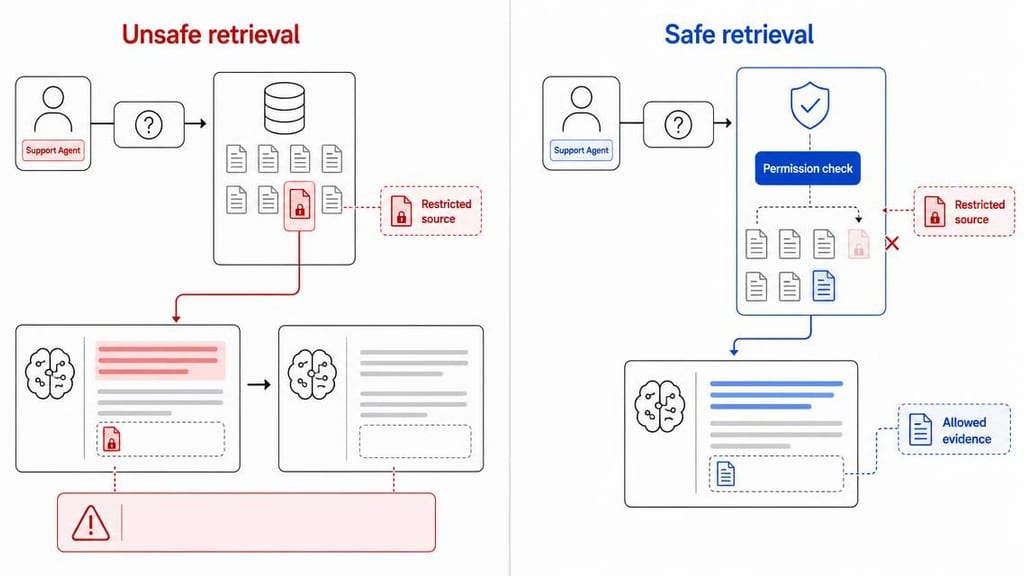
Build access tests into the retrieval layer. Test department boundaries, account boundaries, revoked access, inherited permissions, and deleted documents.
5. Generate with evidence and fallback rules
Require citations for material claims. If retrieval returns weak, stale, or conflicting evidence, the system should ask a clarifying question or route the case to a person.
This fallback is a feature. It prevents fluency from being mistaken for authority.
6. Evaluate the complete loop
Test retrieval and answer generation separately. A poor answer may come from missing content, bad segmentation, weak ranking, or unsupported model synthesis.
Enterprise retrieval also needs a representative question set. The NIST overview of the TREC Enterprise Track is a useful historical reminder that enterprise search evaluation should be tied to realistic information needs, not only generic keyword tests.
A useful operating dashboard tracks:
- whether the expected source appeared in retrieved results;
- whether citations support the answer;
- refusal quality when evidence is insufficient;
- permission and data-isolation failures;
- source freshness and failed ingestion jobs;
- user acceptance, corrections, and escalation;
- response time and cost per completed task.
For organizations integrating older search systems, the ISO 23950 information retrieval specification can provide historical context for standardized search protocol concepts. It does not replace modern permission, metadata, or evaluation design.
Risks, limits, and when to wait
RAG reduces some knowledge gaps, but it does not make generation deterministic.
Instructions can arrive through retrieved content. A document may contain text designed to redirect the model. Treat retrieved text as untrusted data, separate it from system instructions, constrain tool access, and test adversarial documents.
Permissions can drift. Indexes must reflect access changes and deletions. A user leaving a deal team should not retain search access through an outdated index.
Freshness can fail silently. Connector errors may leave apparently credible but obsolete content available. Monitor ingestion age and show document dates.
More retrieval is not always better. Large context sets can mix policies, regions, or versions. Focused filtering and ranking usually matter more than sending additional text to the model.
Search quality can be misread. A fluent response may hide a weak result set. Review retrieved passages independently from the final answer.
Wait before building when documents lack owners, permissions cannot be mapped, or no team can label representative questions. Also wait when simple search filters, process cleanup, or a maintained FAQ would solve the problem at lower cost.
A buyer decision rule
Build RAG when the value of finding the right evidence repeatedly exceeds the cost of maintaining the retrieval system.
Use this test:
If a qualified employee can identify the correct sources and approval boundary for 50 representative questions, the workflow is ready for a RAG pilot. If the team cannot agree on the sources, fix the knowledge process first.
This rule separates an AI opportunity from an unresolved content-governance problem.
FAQ
Should RAG replace enterprise search?
Usually not. RAG adds a generated response over retrieval. Users still need direct search, filters, source previews, and links when they want to inspect evidence themselves. Keep the underlying enterprise search experience available for ambiguous, high-risk, or exploratory requests.
Does every RAG workflow need an AI agent?
No. A cited question-answering interface may be sufficient. Use an agent only when the workflow must take controlled actions, such as updating a CRM or opening a review case. The action layer needs separate permissions, audit events, and approval rules.
Should a company fine-tune a model instead?
Fine-tuning can shape behavior or output style, but it is not the usual answer for frequently changing private knowledge. RAG is better suited to retrieving current evidence. Some systems may use both, but they should have separate objectives and evaluation criteria.
How should a buyer measure an enterprise RAG pilot?
Start with a fixed set of real questions and expected source documents. Measure retrieval success, citation support, refusal quality, permission isolation, response time, and user correction rate. Add one workflow metric, such as reduced preparation time or faster case handling, so the pilot is tied to business value.
What makes permission-aware RAG different from ordinary document chat?
Permission-aware RAG evaluates the user's access before restricted content enters the answer path. It also needs synchronized identity data, document-level or field-level controls where necessary, deletion handling, and tests for revoked access. A visible citation is not safe if the underlying passage should never have been retrieved.
When is a search data store enough without generative answers?
A conventional search experience may be enough when users need exact documents, structured filters, or traceable navigation. Add generation when users need synthesis across permitted sources or a response draft. The decision should follow the workflow, not the novelty of the interface.
What Quellix would build
For most buyers, Quellix would begin with a focused implementation under our Enterprise AI Search and RAG Development service context.
The first release would cover one high-value workflow, a limited source set, permission-aware retrieval, cited answers, and an explicit review queue. We would also build a representative evaluation set before expanding coverage.
A typical path includes:
- workflow and source audit;
- permission and freshness design;
- ingestion, segmentation, and metadata pipeline;
- retrieval and citation interface inside the existing work surface;
- refusal, escalation, and feedback controls;
- production evaluation and phased rollout.
The sensible next step is a technical review of one workflow and 30-50 real questions. That is enough to expose source gaps, access constraints, and whether RAG can improve the decision economically.
The part most RAG demos skip
The visible answer is only the final layer. Durable value comes from source ownership, permission enforcement, retrieval evaluation, and integration with the employee's actual workflow.
Quellix's enterprise AI search and RAG implementation services cover that complete system. The goal is not another isolated chat window. It is a governed retrieval capability connected to the tools where decisions happen.