Real estate analytics software with AI-generated dashboards.
Published
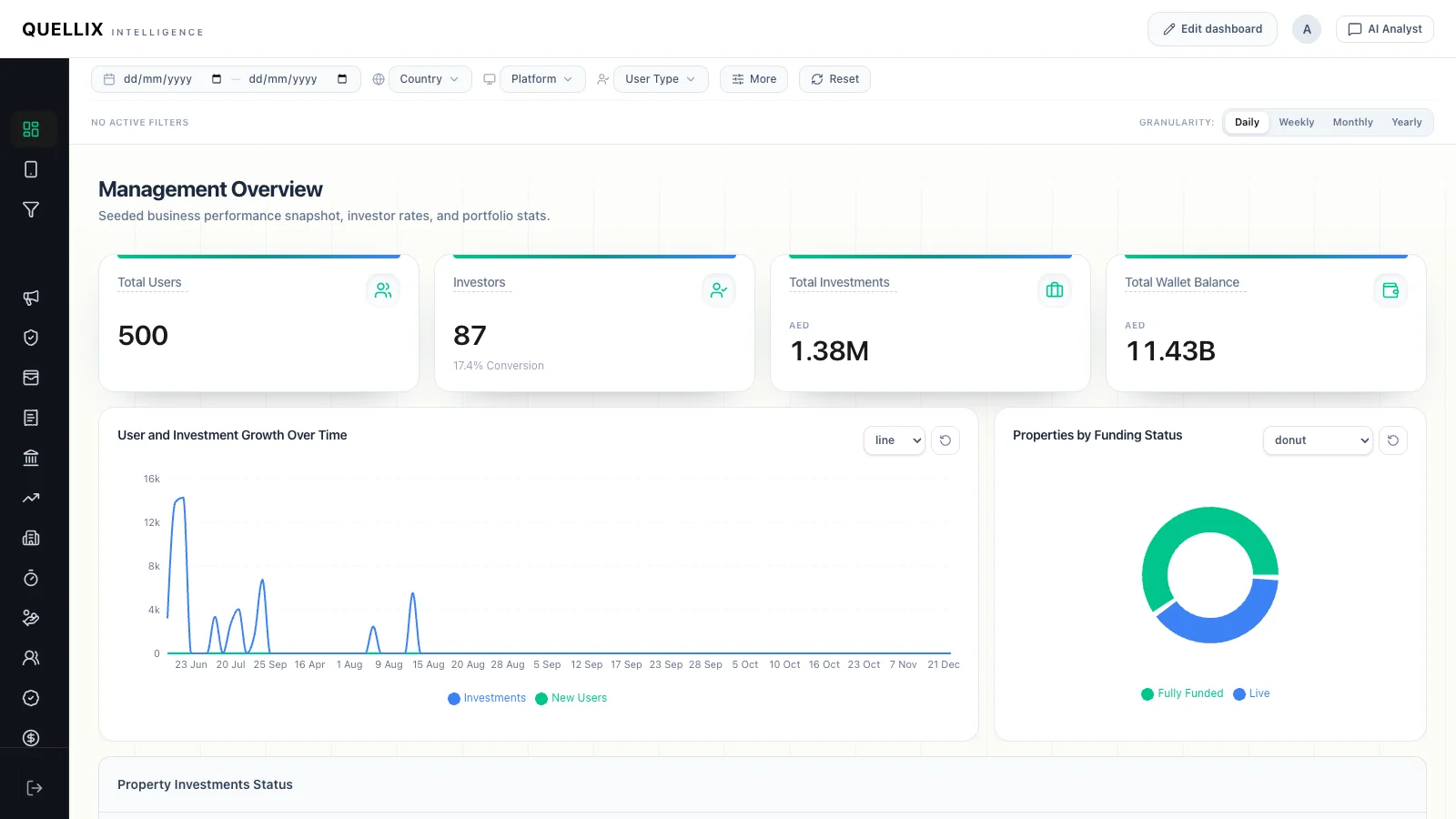
Leadership and operating teams were assembling decisions across property records, investor activity, wallet transactions, mobile-store performance, and conversion reports. Headline metrics existed, but moving from a portfolio question to the underlying users, properties, transactions, or evidence still required switching tools and rebuilding context.
Create one client-specific real estate analytics platform: deterministic investment dashboards for recurring questions, a controlled AI analyst for new analysis, AI-generated dashboards for new reporting needs, and enough evidence for a reviewer to see how every answer was produced.
Watch the implementation
A complete walkthrough of the portfolio dashboards, controlled AI analysis, execution evidence, and natural-language dashboard creation.
How We Built an AI Analytics Workspace for Real Estate Investment
Watch: https://www.youtube.com/watch?v=DQuTCaLxUVk
What shipped
Put portfolio performance and operating detail in one view
The management workspace brings users, investors, invested value, wallet balances, property funding, and transaction activity into the same operating surface. Teams can move from a KPI into the relevant property or transaction detail without rebuilding the analysis in a separate spreadsheet.
Connect product health to investor conversion
Dedicated views track iOS and Android acquisition, uninstalls, ratings, country performance, and version adoption alongside the journey from signup through verification, wallet funding, and investment. Product and growth teams can see where experience quality and funnel performance diverge.
Let the analyst control the view without bypassing controls
A user can ask the AI analyst to apply a supported filter or answer a new database question in natural language. View commands resolve only to valid dashboard state. Analytical questions become parameterized, read-only queries that pass structural, source, cost, and result-limit checks before execution.
Show the evidence behind every accepted answer
Execution details expose the completed stages, final executed SQL, returned row count, and bound parameters. Higher-risk questions receive an independent result comparison. Work is marked verified only when the evidence agrees; otherwise the system clarifies, repairs within a bounded path, or fails closed.
Create a custom dashboard with AI
A user can describe the dashboard they need in natural language. The AI creates a draft with relevant metrics, widgets, filters, and compatible visualizations using the approved data model. The user can then refine the layout, promote reviewed analytical results, and save the dashboard only after reviewing the draft; Cancel restores the previous workspace.
Keep routine analytics cheap and token use bounded
Normal dashboard loads and filter changes run certified queries without a model call, so the most frequent workflows consume no AI tokens. For genuinely new questions, the system sends only the relevant schema and bounded data profiles—not the full catalog or raw dataset—plus the latest eight conversation messages and a compact structured response contract. Risk-based verification avoids a second model path when it is not warranted, while source-aware caching can reuse validated work.
What it looked like in action
Representative mockup using anonymized sample data. The interaction patterns reflect the production flows; names, amounts, IDs, and dates are illustrative.
Business outcomes
Technical work demonstrated
The systems and controls behind the story above.
Certified dashboard query layer
Recurring dashboard metrics use reviewed, deterministic queries with filter-aware drilldowns instead of model-generated SQL on every page load.
Source-aware analytical planning
New questions retrieve only the relevant discovered schema and bounded data profiles, keeping context smaller without hard-coding prompt-specific routes.
Read-only, parameterized SQL execution
The database role, transaction mode, statement timeout, AST checks, bound parameters, row cap, and response-size limit constrain every analytical query.
Risk-based independent verification
Higher-risk analyses are solved through a separate path and compared on normalized results before stronger verification status is shown.
Inspectable execution evidence
The UI reveals the completed stages, final executed SQL, parameters, row count, and verification status without exposing rejected candidates, secrets, or raw database errors.
Natural-language dashboard creation
A controlled AI dashboard generator turns plain-language briefs into custom AI-generated dashboards. It selects supported metrics, widgets, filters, and visualizations, then keeps each result in an editable draft until the user saves it.
Token and inference cost controls
Routine dashboards use zero model calls. New analyses receive a relevance-filtered schema, bounded profiles, eight recent conversation messages, compact structured output, and capped results instead of the full database context. Verification scales with risk, and validated queries can be reused through source-aware caching.
Architecture
Deterministic dashboards for recurring decisions
Management, mobile-store, and funnel views use certified server queries and bounded drilldowns. Normal dashboard use does not require a model call, keeping routine reporting predictable and cost-controlled.
A source-grounded path for new questions
The analyst selects only the relevant schema and bounded profiles, creates a structured request plan, generates parameterized SQL, and executes through a restricted read-only role.
Validation and verification before display
Queries are checked for permitted relations, columns, functions, mutations, cost, and output limits. Risk determines whether an independent solution must agree before the answer can be labelled verified.
Synthetic public walkthrough
The public demonstration uses synthetic users, properties, transactions, dates, locations, and amounts. No customer source records are included in the published walkthrough.
Read-only analytical boundary
AI-authored database work runs inside a read-only transaction through a restricted role with statement and lock timeouts.
Fail-closed query controls
Mutations, unsupported relations, unsafe functions, ambiguous view commands, excessive cost, and oversized results are rejected before display.
Controlled operational disclosure
Reviewers can inspect the final executed query and bound parameters, while rejected candidates, credentials, connection details, and raw database errors remain hidden.
Where this proof applies
This case study supports the solution and service pages below because the same workflow, controls, and handoff model are visible in the implementation.