An AI support agent earns its place when it can move a case forward: find the right evidence, take an allowed action, or hand the issue to someone who can decide. A fluent answer is useful only if the customer actually gets the right outcome.
Take a customer asking why this month's invoice increased. The hard work is identifying the account, finding the subscription change, checking the billing policy, and noticing when those records disagree. This article follows that case through retrieval, tool use, and escalation. It is an illustrative design, not a report of a client deployment.
When this needs an AI agent build
A custom build makes sense when support staff repeatedly gather context across ticketing, CRM, billing, and product systems before they can resolve a familiar request. The case types should have stable policies, identifiable owners, and enough volume to measure the cost of that coordination.
For public FAQs, a search interface or chatbot may be sufficient. An agent becomes useful when the case needs account context, state across several steps, and controlled access to business tools. Before funding the build, pick one request type and name the records it may read, the actions it may take, and the person who owns exceptions.
If billing and CRM cannot reliably identify the same customer, resolve that integration problem first. Giving a model more tools does not repair a broken account map.
What changes when support is handled well
A useful support agent does more than deflect tickets. It removes low-value coordination while preserving accountability.
For customers, that can mean faster acknowledgement, fewer repeated questions, and cleaner transfers. For support teams, it can mean less manual classification, fewer CRM updates, and more time for cases requiring judgment.
The strongest outcome is often not maximum containment. It is minimum customer effort per correct resolution.
That distinction matters. An agent that keeps customers in an automated conversation may improve containment while increasing frustration. A system that recognizes uncertainty and creates a complete handoff may produce better retention and lower rework.
Support leaders should measure:
- Time to first useful response, not merely first response
- Correct-resolution rate by request type
- Reopen and repeat-contact rates
- Human transfer rate and transfer acceptance rate
- Incorrect answer and incorrect action rates
- Time spent gathering context after escalation
- Customer satisfaction by automated, assisted, and human paths
- Cost per correctly resolved case
Measure each outcome by intent, customer tier, channel, and risk level. An overall average can hide weak performance in billing, security, or cancellation workflows.
Customer support workflow: from request to resolution
A production workflow needs separate stages for understanding, answering, acting, and escalating. Treating these as one model prompt makes failures difficult to detect or control.
| Stage | Inputs | System action | Approval or fallback | Business outcome |
|---|---|---|---|---|
| 1. Receive | Email, chat, form, language, attachments | Normalize the request and create a case ID | Reject unreadable or unsupported inputs | One traceable case across channels |
| 2. Identify | Login state, account ID, subscription, product | Confirm identity and retrieve permitted context | Ask for authentication when identity is uncertain | Fewer unsafe account disclosures |
| 3. Triage | Message, history, sentiment signals, service status | Classify intent, urgency, product, and likely owner | Route low-confidence or sensitive cases to a person | Shorter queue delays and fewer misroutes |
| 4. Retrieve | Approved knowledge, policies, account entitlements | Find relevant instructions and check effective dates | Escalate when sources conflict or are missing | More consistent, grounded responses |
| 5. Decide | Intent, evidence, policy, permissions | Select an answer, action, clarification, or transfer | Require approval for bounded high-impact actions | Clear separation between advice and execution |
| 6. Act | Authorized CRM, billing, ticketing, or product tools | Update records or perform an approved task | Stop on permission, validation, or tool failure | Less manual system administration |
| 7. Verify | Tool result, case state, expected outcome | Confirm the action occurred once and record evidence | Reconcile uncertain results before retrying | Fewer duplicates and silent failures |
| 8. Close or escalate | Full event history and unresolved questions | Send the answer or create a structured handoff | Human agent assumes ownership | Cleaner resolution and less repeated questioning |
Search and tool use should remain distinguishable. Microsoft's search and tool use architecture guidance describes these as different capabilities with different design considerations.
Consider a customer asking why an invoice increased.
The agent identifies the account, retrieves the current plan and invoice, checks approved billing explanations, and compares the change with recorded subscription events. It may explain a documented price or usage change.
It should not invent the cause, expose billing data before authentication, or issue an unrestricted credit. If the records conflict, the agent should send billing a handoff containing the customer's question, invoice identifiers, relevant events, sources consulted, and unresolved discrepancy.
The Evidence-Rich Billing Handoff
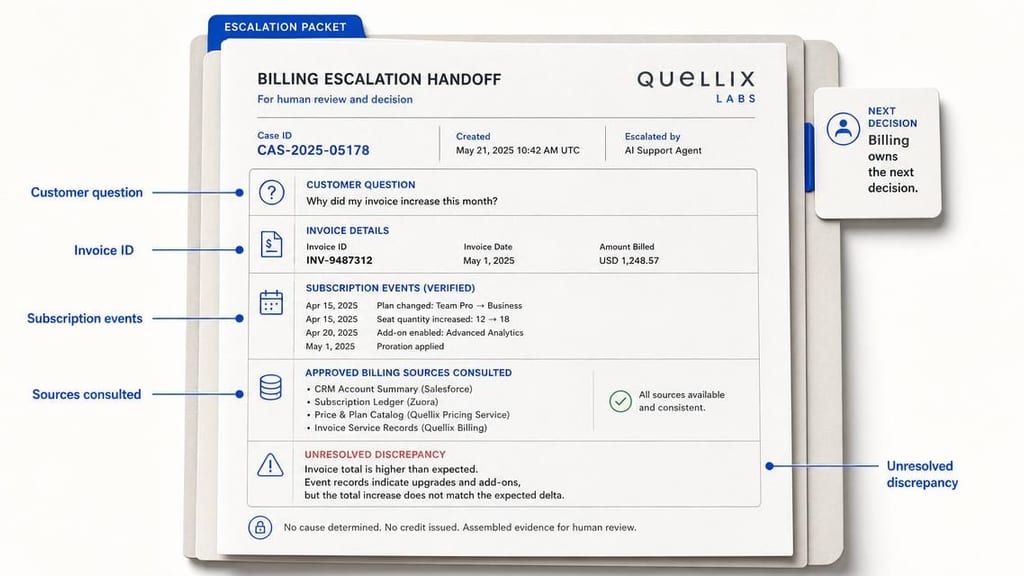
That handoff packet is a non-obvious design priority. Improving it can generate more value than trying to automate every edge case.
Implementation architecture: separate answers from actions
A support agent should not receive broad access simply because it can retrieve an answer. Knowledge access and action authority are different controls.
A practical architecture looks like this:
Customer channel
      ↓
Identity and context check
      ↓
Intent and risk router
      ↓
Approved knowledge retrieval
      ↓
Answer path ── or ── Authorized action tool
      ↓                    ↓
Response check       Result verification
      └──────────┬─────────┘
                 ↓
       Close or human escalation
                 ↓
          Audit and evaluation log
The retrieval layer should enforce the customer's permissions. The action layer should use narrower permissions for each tool. A system allowed to read an invoice should not automatically be allowed to modify one.
Authorization should be explicit at the integration boundary. The Model Context Protocol authorization specification provides a useful reference for protected resource access, token handling, and authorization-server interactions.
Every action also needs an idempotency rule. A retry must not issue two credits, create duplicate replacement orders, or open several identical cases. Tool responses should be checked against the expected result before the workflow continues.
Suppose a permitted credit request times out after submission. The agent does not know whether the billing service created the credit. Retrying with a new identifier could create a duplicate; telling the customer it succeeded could be equally wrong. Store the intended action and its identifier before submission, then check the billing service for that identifier. If the result remains unresolved, hold the case for reconciliation and tell the customer the action is pending.
Approval should also cover the exact proposed change. If the amount, account, or invoice changes after a reviewer agrees, the previous approval no longer covers the new request. This is application state the workflow must enforce, rather than a reminder buried in the prompt.
Use deterministic business rules where the policy is already clear. Code should enforce a refund limit or prohibited account state. The language model can interpret the request, but it should not redefine the limit.
Approval boundaries by support risk
A useful starting point is to separate support work into three operating zones. These are design recommendations; each business must set its own boundaries.
| Zone | Example requests | Recommended authority |
|---|---|---|
| Low risk | Public product questions, case status, approved setup instructions | Agent may answer or complete a reversible action |
| Controlled | Account troubleshooting, small policy-bound credits, subscription changes | Agent drafts or acts within strict limits; exceptions require approval |
| Restricted | Data deletion, security incidents, legal threats, disputed charges, vulnerable customers | Immediate human ownership; agent gathers context only |
Boundaries should depend on impact, reversibility, identity confidence, and evidence quality. A familiar request is not automatically low risk.
The NIST Generative AI Profile recommends managing generative AI risks across the system lifecycle. For support operations, evaluation must cover more than answer quality. It should also cover data exposure, tool use, monitoring, and human response.
Agentic systems also create risks around excessive permissions, prompt injection, unsafe tool calls, and weak monitoring. OWASP's Agentic AI threats and mitigations guidance is a useful security input when defining tool boundaries and escalation behavior.
Tell customers when they are interacting with an automated agent and make human contact easy to find. Review the disclosure wording for the actual product and market before launch.
Risks, limits, and when to wait
Do not automate customer-facing answers when source material is stale, contradictory, or ownerless. The agent will make those knowledge problems more visible, not solve them.
Wait when request volume is low and each case is materially different. A guided workspace for human agents may deliver more value than autonomous handling.
Also wait when the workflow lacks stable identifiers. If the support platform, CRM, and billing system cannot agree on the customer or case, an agent can accelerate incorrect updates.
Other practical limits include:
- Customers changing intent midway through a conversation
- Attachments containing hidden instructions or unrelated sensitive data
- Knowledge articles that conflict with contractual terms
- Tool outages that leave an action in an uncertain state
- Emotionally charged requests where a technically correct answer is still inappropriate
- Regional policy differences that the routing layer fails to detect
- Escalations that omit the evidence a human needs to decide
Security and privacy reviews should document retained conversation data, connected systems, vendor access, and audit visibility. Do not promise that customer information is isolated until the architecture and contracts support that promise.
A rollback plan is equally important. Disable a tool, route a request type to humans, or revert to agent-assist mode without losing case history. Every automated action needs a named operational owner.
A rollout path that produces evidence
Start with historical cases. Select two or three high-volume intents and label the correct routing, evidence, response, action, and escalation decision.
Next, run the agent in observation mode. It recommends decisions without contacting customers or changing records. Compare its work with actual outcomes and review disagreements.
Then move to agent-assist mode. Support staff can accept, edit, or reject drafts and proposed actions. Capture why they intervene. Those reasons become evaluation cases and policy improvements.
Only then allow autonomous handling for a narrow, low-risk segment. Expand by request type, not by a blanket percentage of all tickets. Maintain a rollback path and a named owner for each automated action.
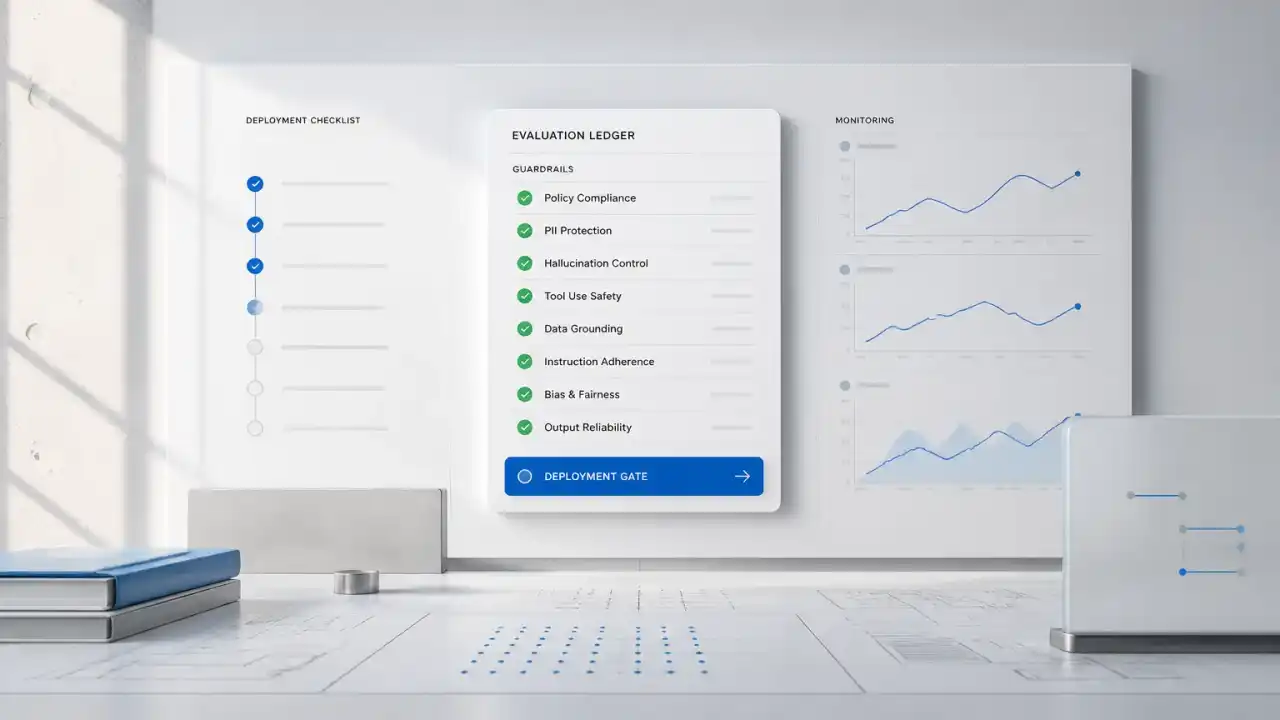
Evaluation should include adversarial cases, permission failures, stale sources, duplicate requests, ambiguous identity, and tool timeouts. Track both model behavior and business outcomes. A high answer score cannot compensate for an unsafe CRM update.
What Quellix would build
For this billing case, our AI agent development service would start with the account map, invoice records, support policies, and escalation owner. We would implement the read path first and test whether the system can explain documented changes or recognize an unresolved discrepancy.
The next release could add narrow tools for ticket updates and selected account actions. Each tool would have an explicit permission check, validated inputs, a durable action record, and a way to reconcile uncertain results. Reviewers would receive the evidence packet shown above instead of a conversation transcript they must interpret from scratch.
The pilot would compare correct resolutions, reopened cases, and time spent preparing handoffs with the current support process. We would keep an agent-assist mode available so a weak request type or failing tool can return to human handling without losing case history.
If staff cannot reliably find current policies, enterprise AI search and RAG implementation may be the first dependency. Bring one recurring case type and a few anonymized examples to the engineering discussion; they reveal more than a target automation percentage.
Related Reading
- AI Agent vs Chatbot: Choosing the Right Build
- AI Agents: Workflows, Approvals, and Guardrails
- EU Transparency Guidance Changes Customer AI Workflows
FAQ
Should an AI support agent replace the help desk?
Usually not. Its best role is to handle bounded work, assist staff, and improve escalations. Humans should retain ownership of sensitive, ambiguous, or high-impact cases.
How much autonomy should the first release have?
Start with recommendations or drafts. Add autonomous actions only after historical and live evaluations show acceptable performance for a specific request type. Keep permissions narrow and provide a fast human fallback.
What should buyers test in a proof of concept?
Test correct routing, evidence quality, permission enforcement, tool failures, duplicate prevention, escalation quality, and customer outcomes. A polished demo conversation is not enough.
Which support actions should an agent never perform alone?
It should not independently handle actions with irreversible effects, uncertain identity, legal significance, security impact, or material financial exposure. Examples include data deletion, unrestricted credits, disputed-charge decisions, and security-incident resolution.
What must a human escalation contain?
It should include the customer's stated issue, verified identity and account context, intent and urgency, sources consulted, actions attempted, tool results, relevant identifiers, and unresolved questions. A complete packet prevents the customer from repeating the case.
How can a company prevent duplicate or unsafe CRM actions?
Give each tool a narrow permission set, validate required fields, use idempotency keys, and verify the result before retrying. Log the request, authorization decision, tool call, result, and human override.
When is enterprise AI search a better first investment?
Choose search and retrieval first when support staff cannot find current, permission-aware answers. An agent cannot reliably act when its evidence is incomplete, contradictory, or disconnected from customer entitlements.