EU Transparency Guidance Changes Customer AI Workflows
A customer asks a support assistant whether a refund is approved. The assistant can draft a helpful answer in seconds. But can it clearly identify itself, explain what happened next, hand the case to a person when needed, and leave a usable record?
That is now a product and operating question, not a legal footnote. The European Commission published final guidance on AI transparency obligations under Article 50 on July 20. The guidance gives providers and deployers more detail on how to approach disclosure obligations for certain AI interactions and AI-generated content. The Commission's final guidance materially changes what buyers should ask for before approving a customer-facing AI build.
For operators, the cost of getting this wrong is usually practical before it is legal. Customers lose confidence when they cannot tell whether they are dealing with a system or a person. Service teams inherit unclear escalations. Product teams cannot reconstruct why an agent sent a particular message. Compliance teams discover too late that no one retained the evidence needed to review the workflow.
The useful response is not to add a disclaimer at the bottom of a chat window. It is to design transparency into the workflow: at the interaction point, at the approval point, and in the operating record.
When this needs an AI agent build
Move from research to an implementation conversation when your system does more than generate internal drafts. An AI build deserves serious design when it can send messages, update a CRM, route a case, make a recommendation that affects a customer, or act across several business systems.
That is especially true if the workflow has all three conditions:
- It interacts directly with customers, candidates, suppliers, or the public.
- It uses a model to interpret unstructured language, documents, or intent.
- It can trigger an operational change without a person reviewing every step.
A support bot that only searches approved help articles may need a lighter control set than an agent that checks order status, offers an exception, opens a return, and emails the customer. The latter has an identity, a decision path, and real business consequences.
The recent guidance is relevant because Article 50 addresses transparency duties around systems intended to interact directly with natural persons, as well as certain AI-generated or manipulated content. The legal text also sets conditions and exceptions that must be assessed in context. Read the Article 50 text on EUR-Lex with counsel for a determination that fits your role, markets, and use case.
For a buyer, the decision rule is simpler: if an AI agent is customer-facing and can take action, treat transparency as a workflow requirement from day one. Do not treat it as copywriting added before launch.
What changed for product and operations teams
The Commission's guidance does not turn every automated workflow into the same type of regulated system. It does, however, make the design questions more concrete. Its companion quick-facts page highlights the practical focus on informing people when they interact with AI systems in applicable cases and on transparency around certain AI-generated content. The Commission's quick facts are a useful starting point for product owners deciding which surfaces need review.
For a customer workflow, that creates four design jobs.
First, identify the AI interaction clearly and at the right moment. A buried privacy-policy reference is rarely operationally useful. A customer should understand before relying on an answer whether an AI system is participating in the exchange.
Second, separate drafting from authority. A model may compose a response, but the workflow should make clear whether it is providing information, recommending a next step, or completing a transaction.
Third, give the person a meaningful path out. That can be a live-agent handoff, a review request, or a structured appeal route. The right choice depends on the decision's impact and reversibility.
Fourth, preserve the operating evidence. Teams need to know what the customer saw, what data the system used, which tools it called, which rule permitted the action, and whether a human intervened.
The non-obvious lesson is that disclosure without state tracking is weak. You may tell a customer they are speaking with an AI assistant, yet still be unable to prove which version of the workflow handled their case or why a handoff did not occur. The control is not the label. The control is the combination of clear notice, constrained actions, and a reviewable event trail.
The Reviewable Customer-AI Case Record
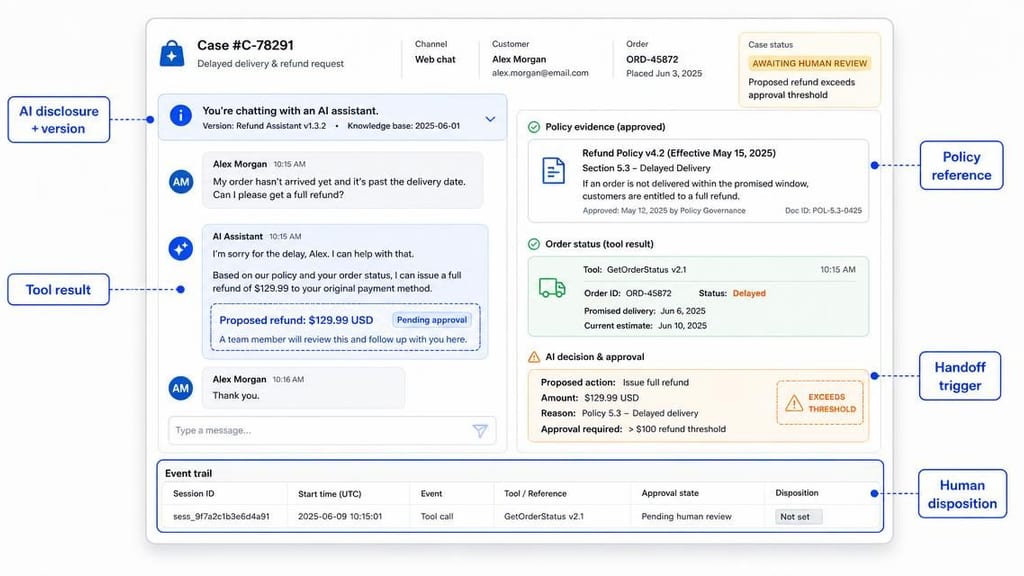
A customer-support workflow that can stand up to review
Consider an e-commerce support operation handling delayed-delivery and refund requests.
Inputs: The customer submits a chat message, order number, and delivery concern. The agent receives only the customer profile, order details, carrier status, and policies needed for that case.
System action: The assistant identifies itself as an AI assistant, retrieves the approved refund policy, checks the order system, and classifies the request. It can answer a tracking question or draft a proposed remedy. It writes a structured case note into the CRM rather than a free-form summary alone.
Approval point: If the proposed refund exceeds a set threshold, the order data conflicts, the customer disputes a prior decision, or the agent detects frustration or ambiguity, it stops. A service representative sees the conversation, tool results, policy references, and proposed action in one review queue.
Fallback: If a connected system is unavailable, the agent does not invent an answer. It creates a case, tells the customer that a team member will review it, and records the failure reason.
Business outcome: Customers get faster answers for routine cases. Service agents receive cleaner, better-contextualized escalations. Leaders can measure containment, reopens, exception rates, and human overrides instead of relying on a generic satisfaction score.
This design also improves operational discipline outside Europe. Clear system identity reduces customer confusion. Event records make quality reviews faster. Approval thresholds stop a helpful chatbot from becoming an uncontrolled transaction engine.
The Workflow Architecture buyers should request
A strong request for proposal should ask less about the underlying model and more about the operating boundaries around it.
Start with a channel layer. It shows the right disclosure in chat, email, voice, or embedded product flows. The wording and placement should match the channel and the user's task.
Add a policy and knowledge layer. The agent should retrieve approved policies, current product information, and permissions-aware customer data. It should not use an unrestricted pile of internal documents as a source of truth.
Then create an action layer. Each tool call needs a clear scope: read order status, create a ticket, update a CRM field, or draft an email. Higher-impact actions should require a business rule or human approval.
Finally, build an evidence layer. Capture the session identifier, disclosure version, source references, tool calls, outputs, confidence or exception signals, approvals, and final disposition. Retention periods and access controls should follow your legal and security requirements.
The evidence layer often receives the least attention in prototypes. It is also what turns a demo into an operable system. Without it, a team cannot investigate a customer complaint, tune an escalation rule, or distinguish a model issue from a broken integration.
The Commission's transparency guidance should be read alongside the broader implementation context described in its AI Act navigation FAQ. Buyers should involve legal and privacy stakeholders early, but should not wait for a perfect governance program before mapping one bounded workflow.
Risks, limits, and when not to build
Not every customer process should become an autonomous agent.
Do not automate a workflow yet when the policy itself changes weekly, staff routinely make exceptions without recording why, or the underlying customer data is unreliable. In those conditions, automation can amplify inconsistency and make a weak process harder to audit.
Also wait when there is no meaningful fallback. If a wrong answer could cause material customer harm and there is no staffed escalation route, the appropriate first step may be an internal assistant that drafts responses for human review.
Avoid a false sense of safety from disclosure alone. Transparency does not correct inaccurate retrieval, biased routing, weak identity controls, or an integration that posts the wrong CRM update. It also does not decide whether an exception in Article 50 applies to a specific deployment. That assessment requires legal judgment.
There is a trade-off in every approval design. Review every message and you may remove most of the operational benefit. Review nothing and you may create expensive edge cases. The better pattern is to automate stable, reversible actions and route uncertain, high-value, or emotionally sensitive cases to people.
For generated or manipulated content, product teams should also avoid treating a single watermark or label as a complete program. The Commission's FAQ on its transparency code of practice explains the code's role in supporting transparency practices. In production, buyers still need ownership, content handling rules, incident routes, and a way to verify that the expected disclosure appeared in the relevant channel.
What Quellix would build
For this use case, Quellix would approach AI agent development services as a controlled customer-operations system, not a generic chat interface.
The first deliverable would be a workflow map: the customer intents, approved data sources, actions the agent may take, mandatory handoff triggers, and the evidence required for review. We would then build the narrowest useful version first, such as order-status support or lead qualification, before allowing higher-impact actions.
A practical implementation path includes:
- Instrument one channel with clear AI interaction notices and versioned messaging.
- Connect only the systems required for the initial job, such as a help desk, order platform, or CRM.
- Set action permissions and approval thresholds with operations leaders.
- Create review queues for exceptions, low-confidence retrieval, sensitive requests, and system failures.
- Run production-like tests using real historical cases, including incomplete data and adversarial customer prompts.
- Monitor outcomes through an operating dashboard: automation rate, escalation rate, approval reversals, reopen rate, and customer-impact incidents.
The right next step is a technical review of one live workflow. Bring a representative set of conversations, the systems it touches, and the actions your team wants to automate. That is enough to identify where disclosure belongs, what needs approval, and whether the business case supports a build.