GPT-5.6 Model Routing for Approval Workflows
Most AI pilots fail to create a business case for one simple reason: every request gets treated as if it deserves the same model, the same level of review, and the same operational risk.
OpenAI's July 9 GPT-5.6 release materials make model selection a more immediate production decision. The release, its system card, and its API documentation place capability, deployment safety, and model-specific economics in the same buyer conversation. OpenAI's announcement and model documentation are a useful prompt to revisit an assumption that still appears in many roadmaps: that an agent needs one default model.
It usually does not.
For a support leader, the real question is not, "Which model is best?" It is, "Which requests can be handled cheaply and safely, which require deeper reasoning, and which must stop for a person?" That answer affects response times, operating cost, customer risk, and whether a team can expand beyond a controlled pilot.
When this needs an AI agent build
Move from research to an implementation conversation when a workflow has all four of these conditions:
- It starts with a repeatable business event, such as a support ticket, a renewal signal, a sales lead, or a supplier invoice.
- It requires information from known systems, such as a CRM, knowledge base, help desk, ERP, or contract repository.
- It has a clear action that can be drafted, recommended, or completed with limits.
- Someone can define which outcomes need approval and what should happen when the system is uncertain.
GPT-5.6 is relevant when your team is already comparing model capability, cost, and deployment controls rather than simply experimenting with a chat interface. OpenAI published a dedicated GPT-5.6 system card, while Microsoft documents GPT-5-series reasoning-model deployment considerations in its Azure OpenAI guidance. For buyers, that combination reinforces a practical point: model choice belongs inside the workflow design, not at the end of procurement.
An implementation conversation is worthwhile if your team can name one queue with enough volume or consequence to measure. Good starting points include high-value support escalations, lead qualification, renewal-risk reviews, contract intake, and account research before sales calls.
Do not start with "an AI employee." Start with one queue, one decision, and one accountable owner.
What changed for buyers
The GPT-5.6 materials describe the GPT-5.6 family and model variants including Sol, Terra, and Luna in OpenAI's preview communication. OpenAI's preview and the subsequent product release give buyers a concrete reason to design routing rules instead of assuming a single-model architecture.
This is not mainly a procurement detail. It changes the shape of an AI workflow.
A production system can send straightforward classification or extraction work through a lower-cost route. It can reserve a deeper reasoning route for exceptions that have more ambiguity or commercial impact. It can place a human reviewer between a proposed action and a customer-facing or system-changing outcome.
That architecture is more valuable than a blanket instruction to "use the strongest model." A strong model used on every ticket may produce useful answers, but it can also make operating cost unpredictable and hide the cases where the workflow itself is weak.
The buyer outcome is a controllable service level. Teams can decide which cases deserve fast automation, which deserve thoughtful drafting, and which should stay in an expert queue.
The Workflow Architecture: route the decision, not just the prompt
Consider a B2B support team handling requests about billing, product configuration, access, and contract terms.
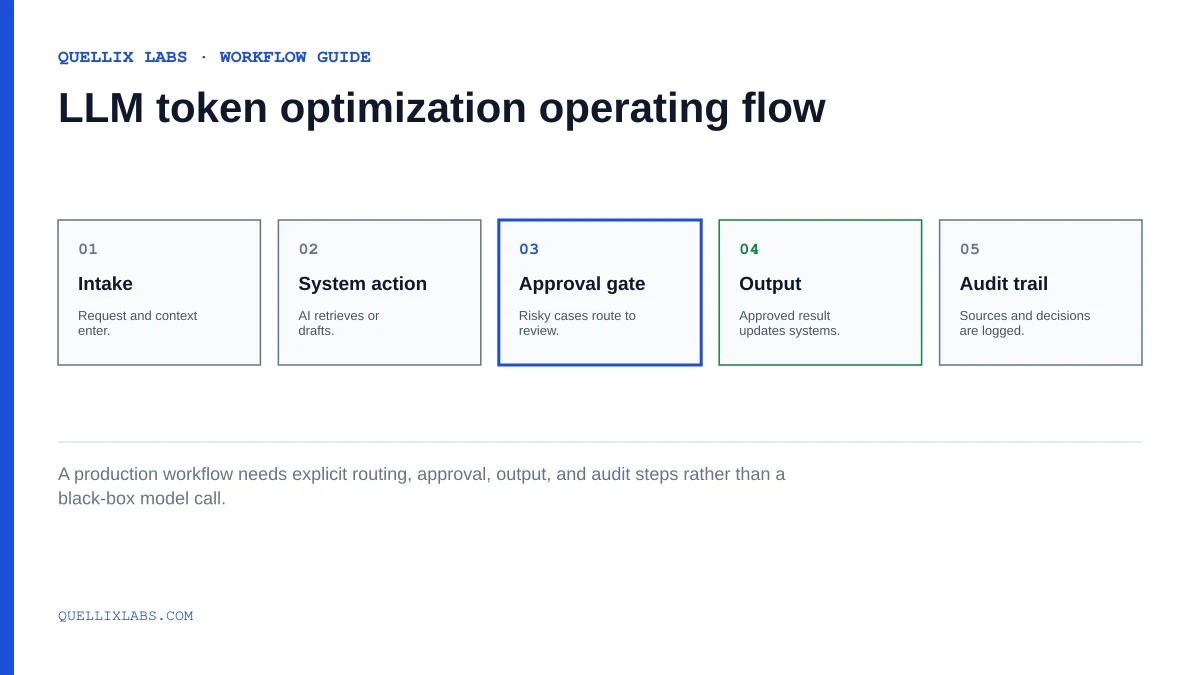
LLM token optimization operating flow
 Open the Pinterest-ready portrait graphic
The incoming ticket is the input. The system first checks the customer identity, account tier, product area, and whether the request contains sensitive topics. It retrieves only the support articles, account records, and policies that the user is permitted to see. Then it classifies the request into a route.
A low-risk route might draft a response to a known configuration question. A medium-risk route might prepare a billing explanation from CRM and invoice data. A high-risk route, such as a contract interpretation, account-credit request, or security concern, should create a structured brief and wait for a human owner.
The key design choice is that routing happens before an irreversible action. The model does not get to decide alone whether it may send a credit, change a record, or make a policy commitment.
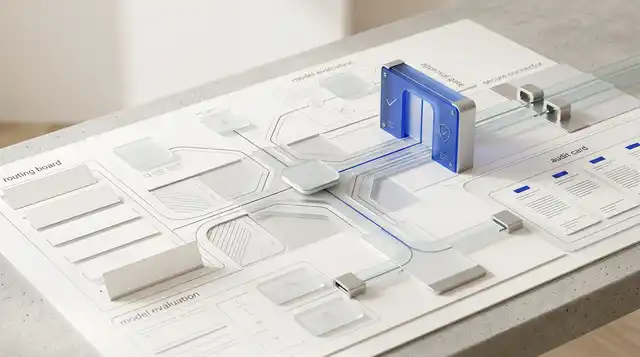
{"id":"gpt56-approval-routing","type":"workflow_diagram","title":"Support routing with approval gates","placement":"The Workflow Architecture","altText":"Workflow diagram showing a support ticket classified and routed to retrieval, a response draft, a human approval gate for high-risk cases, and an audited CRM update.","caption":"The model route should match the decision risk, not merely the length of the ticket.","steps":[{"label":"Ticket intake","detail":"Classify topic and account risk","state":"input"},{"label":"Retrieve","detail":"Gather permitted account context","state":"action"},{"label":"Draft route","detail":"Select response and model path","state":"action"},{"label":"Approval gate","detail":"Review high-impact actions","state":"approval"},{"label":"CRM audit","detail":"Log sources, outcome, owner","state":"audit"}]}The business outcome is not simply a drafted reply. It is a faster resolution path for routine cases, fewer manual searches for agents, and a visible review trail for exceptions.
This also makes evaluation possible. Rather than judging an agent on a vague sense that it "seems helpful," a support leader can measure routing accuracy, edit rate, escalation rate, time to first response, and the rate of actions blocked by policy.
A better rule for LLM token optimization
Many teams treat LLM token optimization as a prompt-shortening exercise. Reducing needless context helps, but it is not the highest-value decision.
The larger opportunity is to avoid spending expensive reasoning effort on work that has no decision consequence. A short ticket can still be high risk if it asks for a refund or a contract exception. A long ticket can be low risk if it only needs a cited answer from an approved product guide.
A more useful routing rule uses three signals:
- Decision impact: Can the output change a customer commitment, financial record, access right, or commercial position?
- Evidence quality: Does the system have authoritative, permission-checked information to support the answer?
- Recoverability: Can a wrong action be corrected before it reaches a customer or downstream system?
High-impact, poorly supported, or hard-to-reverse cases should go to review. Low-impact cases with strong evidence can move faster.
This is the non-obvious lesson: route according to the cost of being wrong, not the apparent complexity of the request. That rule makes cost control and governance reinforce each other instead of competing.
OpenAI's GPT-5.6 API documentation should be read as an engineering input to this design, alongside the workflow's own volume, latency, and quality data. Pricing and model capability can inform a route, but neither replaces an approval policy.
A practical Build Path for one business queue
A sensible first deployment usually covers one bounded workflow for four to six weeks of observed operation.
First, map the queue. Pull a representative sample of tickets, leads, documents, or alerts. Label the intended outcome, the required data sources, the acceptable action, and the cases that should always escalate.
Second, define a route ledger. For each route, record the trigger, model path, maximum permitted action, required evidence, reviewer role, fallback, and success measure. This becomes much more useful than a generic prompt library.
Third, connect systems in read-first mode. A lead-research agent may read a CRM, account history, and public notes, then draft a research brief. It should not write to CRM fields until the business owner has verified that the recommended fields are accurate and useful.
Fourth, launch with controlled write permissions. For example, an agent can create a proposed CRM task, but a sales manager approves any stage change. A document extraction workflow can populate an invoice-review screen, but an accounts-payable reviewer approves supplier, amount, tax, and coding exceptions before posting.
Fifth, review the failures every week. Look for wrong routes, missing information, unsupported claims, duplicate actions, and reviewer edits. Those findings should change routing thresholds, retrieval filters, and fallback rules.
The relevant GPT-5.6 safety material is not a replacement for this work. The system card is useful context for a buyer's model assessment, while the operating controls remain the responsibility of the team deploying the workflow.
{"id":"model-route-decision-matrix","type":"decision_matrix","title":"Choose the route before automation","placement":"A practical Build Path","altText":"Decision matrix comparing low, medium, and high-impact workflow routes by evidence quality, allowed action, review requirement, and fallback path.","caption":"A route ledger lets teams change models without weakening business controls.","columns":["Route","Evidence","Allowed action","Review","Fallback"],"rows":[["Low impact","Approved source","Draft or classify","Sample check","Queue ticket"],["Medium impact","Account data","Create proposal","Manager review","Assign owner"],["High impact","Mixed evidence","No direct action","Required approval","Escalate expert"]]}Risks and limits: when not to build yet
Do not automate a process that has no stable policy. If two senior people cannot agree on how to handle a renewal exception, an agent will only make that disagreement faster and harder to audit.
Wait if source permissions are unclear. A helpful response is not acceptable if it mixes one customer's account context with another's. Retrieval and access checks must be designed before an internal assistant can be trusted with sensitive systems.
Also wait when the team cannot absorb exceptions. An AI system can increase the number of cases that reach review. If nobody owns that review queue, the result is delayed responses and frustrated staff, not leverage.
Finally, do not promise full autonomy based on a polished demo. A model can produce a plausible explanation without having the right evidence. Your workflow needs a no-answer path: when approved data is missing, it should state that clearly, create a task, or route to the right person.
The release may broaden the model options available to a buyer, but it does not eliminate these operational limits. Microsoft's reasoning-model guidance is a reminder that deployment decisions include platform and implementation details, not just model selection.
What Quellix would build
For this use case, Quellix would apply its AI agent development services to one production queue rather than deploy a broad assistant.
The first version would include system connectors, permission-aware retrieval, a routing policy, explicit approval gates, a review queue, fallback paths, and an evaluation dashboard. It would log the source material used, the selected route, the proposed action, the approver, and the final outcome.
For the support example, that means an agent that can classify tickets, retrieve approved account and knowledge-base context, draft replies, and create CRM follow-ups. It cannot issue credits, alter access, or make contract commitments without the correct approval.
The practical next step is a technical review of one existing queue. Bring 30 to 50 real examples, the systems involved, and a list of actions your team will and will not delegate. That is enough to decide whether routing can create a measurable gain, or whether the process needs clearer policies first.