Engineering Reliable Sales Agents: A Decision Framework for B2B Leaders
Sales is increasingly a game of speed and context, yet most B2B sales teams are drowning in "admin debt." High-value account executives spend more time updating CRM records, researching prospects, and drafting follow-ups than they do in actual discovery calls. When a lead shows intent, the gap between that signal and a meaningful human response is often measured in hours or days, not minutes.
For founders and sales leaders, the promise of an "AI Sales Assistant" is tempting. But there is a massive delta between a basic chatbot that answers internal questions and an Agentic Sales System that autonomously executes high-stakes workflows. To bridge this gap, leaders must move beyond the hype of generative AI and focus on the engineering standards that ensure reliability, governance, and actual ROI.
The Shift from AI assistant to operating loop
Most current AI tools in the sales stack are passive. They sit in a sidebar (a "AI assistant") and wait for a human to ask for help. While useful for drafting an email, they don't solve the fundamental bottleneck of operational execution.
At Quellix Labs, we define the next generation of sales technology through the agent operating model.
- Reason: The system analyzes a signal-such as a new inbound lead or a change in a prospect's LinkedIn profile-and determines the necessary objective based on sales playbooks.
- Act: The system interacts with external tools, such as your CRM (Salesforce, HubSpot), lead intelligence databases (Apollo, ZoomInfo), or communication platforms (Slack, Email).
- Verify: The system checks its own work against pre-defined constraints or routes the output to a human for approval before final execution.
This shift moves the AI from a creative writing tool to an operational engine. However, building this engine requires more than just a clever prompt; it requires a commitment to durable execution and observability.
The Workflow: Automated Lead Research and Outreach Orchestration
To understand how this works in practice, let's examine a common high-friction workflow: The Lead-to-Meeting Pipeline.
The Problem
When a high-value lead signs up for a webinar or downloads a whitepaper, a junior rep (SDR) usually manually researches the company, checks for existing accounts in the CRM, looks up the person's recent posts, and then chooses a sequence. This process can create a growing queue when lead volume spikes. Measure research time and response delay from your CRM before estimating the value of an agent.
The Agentic Solution
We build an automated pipeline using a "Signal-to-Action" model combined with an extraction-to-review pipeline.
- Input: A webhook triggers the workflow when a form is submitted.
- System Action (The operating loop):
- The agent queries the CRM to check for existing relationships.
- It scrapes the prospect's company website and recent 10-K filings to identify "Top 3 Strategic Priorities."
- It synthesizes this data into a personalized outreach draft that references a specific business pain point.
- Human Approval Point (The Fallback): Instead of the agent sending the email automatically, it pushes a notification to a Slack channel or a CRM task queue with the research summary and the draft. The rep can "Approve," "Edit," or "Reject."
- Evaluation target: Shorten the signal-to-review delay and shift SDR time from repeated research to evidence review. Measure response time, accepted drafts, and downstream conversion quality during the pilot.
Implementation Lesson: The Fallacy of the "Stateless" Agent
A common mistake in building AI sales assistants is treating them as stateless scripts. In reality, sales cycles are long and complex. If an AI agent is researching a lead and the API it's calling times out, a simple script would fail, and the lead would be lost in the cracks.
For enterprise-grade reliability, we utilize Durable Execution. As documented by Temporal.io, durable execution ensures that the state of your workflow is preserved even if the underlying server fails or an API is down. If your sales agent is mid-way through a complex research task and hits a rate limit, a durable workflow will simply pause and resume exactly where it left off once the limit resets. This is the difference between an experimental toy and a production-grade system.
The Buyer's Decision Rule: When to Build vs. When to Buy
Before investing in a custom AI build, we advise sales leaders to apply the 80/20 Persistence Rule:
- Buy when most of the target process fits a generic tool's supported workflows and the remaining exceptions do not justify a custom operating layer.
- Build if your competitive advantage lies in your unique data, your specific technical discovery process, or your complex multi-stakeholder approval workflows.
If your sales process requires crossing data from a proprietary product database with external market signals to generate a "Next Best Action," a generic SaaS tool will likely fail. This is where a custom AI Agent, built on a foundation of durable execution and long-running workflows, becomes a strategic asset.
Risks and Limits: Why You Shouldn't Automate Everything
Automation carries risk, particularly in sales where brand reputation is on the line. According to the NIST AI Risk Management Framework, AI systems must be "valid and reliable, safe, secure and resilient, accountable and transparent."
When Not to Build
Do not build a fully autonomous AI sales agent if:
- Low Data Volume: If you only handle 5 high-value deals per year, the cost of building and maintaining an agent outweighs the manual effort of a human.
- High Variability: If every single deal requires a completely different, non-linear approach that cannot be mapped to a playbook, AI will struggle to provide value beyond basic drafting.
- Unstructured Chaos: If your CRM is a "data graveyard" with no consistency, an AI agent will simply automate the distribution of bad information.
The Governance Requirement
We mitigate these risks by designing governance into AI workflows. This involves setting hard constraints-such as "never send an email to a domain on the 'Do Not Contact' list"-and ensuring every action taken by the agent is logged.
For technical leaders, this means implementing Observability. Using OpenTelemetry, we can trace exactly why an agent made a specific decision. If a sales agent recommends a specific discount, we need to be able to see the "trace" of data points that led to that recommendation to ensure it aligns with company policy.
The Operating Model: Building for Transparency
When we deploy an AI Sales Assistant, we don't just hand over a black box. We implement a "Cited Knowledge Loop." Every piece of research the agent provides must be linked to its source. If the agent claims a prospect's company is expanding into the EMEA market, it must provide the link to the press release or job posting where it found that information. This is part of our Enterprise AI Search and Knowledge Base standard, ensuring that sales reps can trust the data they are using in their pitches.
Architecture of a Governed Sales Agent
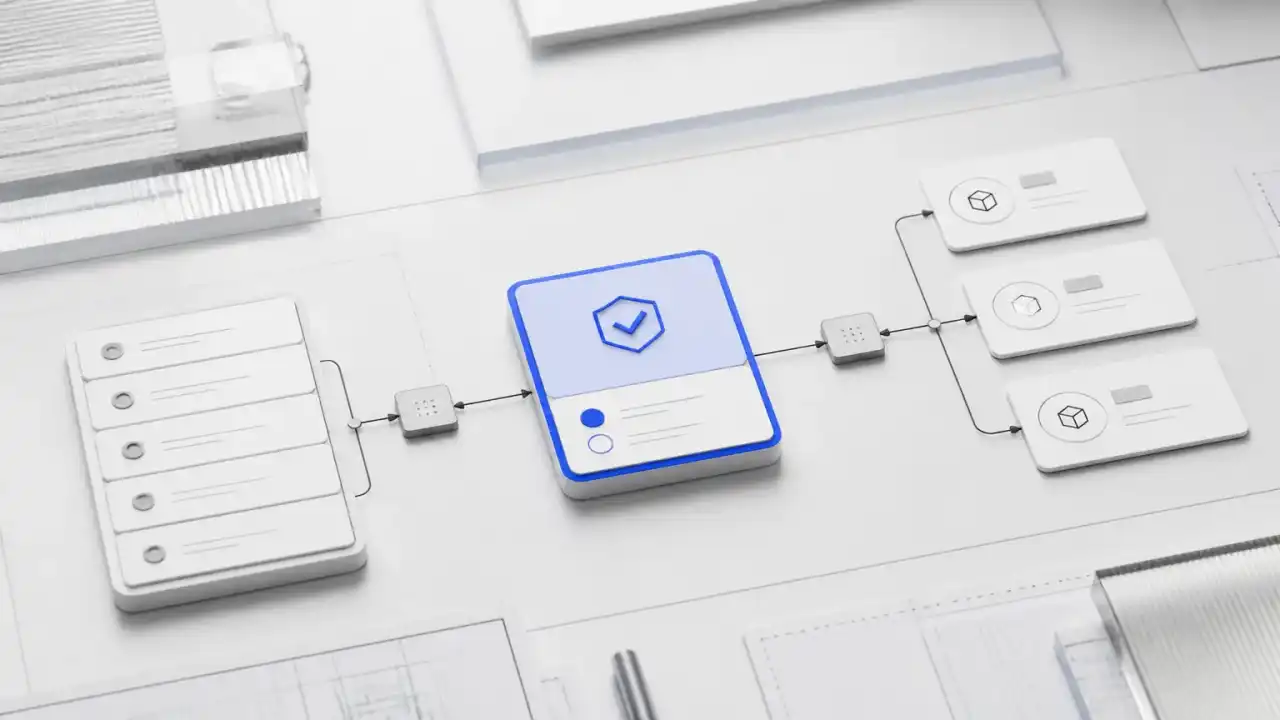
A robust architecture for a sales agent generally follows this pattern:
- Orchestration Layer: Using tools like Google Cloud Workflows or AWS Step Functions to manage the sequence of tasks.
- Reasoning Engine: An LLM (Large Language Model) that interprets intent but is constrained by specific system instructions.
- Integration Layer: Secure connections to your CRM and external APIs, often managed through a middleware that handles authentication and rate limiting.
- Monitoring Layer: A dashboard that tracks agent performance, error rates, and human intervention frequency. This is critical for observability in agentic AI systems.
Conclusion: The Path Forward
The goal of an AI sales assistant is not to replace the salesperson, but to remove the "robotic" parts of the salesperson's job. By automating lead research, CRM data extraction, and initial outreach drafting within a governed framework, companies can significantly increase their pipeline velocity without increasing headcount.
The first step for any leader is a technical review of their existing sales data and workflows. Are your processes documented well enough for an agent to follow? Is your data accessible via API? If the answer is yes, the ROI of a custom build is likely substantial.
Related Reading
- Durable Execution: The Architecture of AI Agents That Actually Finish the Job
- Scaling B2B Revenue With Agentic Workflows: From Copilot Help to Governed Pipeline Action
- Monetizing Agentic Workflows in Sales and Support: The ROI Comes From Handoff, Not Chat
- Designing Governance into AI Workflows: Approval Points and Fallback Paths