Designing Governance into AI Workflows: Approval Points and Fallback Paths for Reliable Automation
The most common reason enterprise AI projects stall isn't a lack of intelligence in the model; it is a lack of trust in the outcome. For a founder or sales leader, the prospect of an AI agent sending an unvetted, hallucinated discount code to a Tier-1 prospect is enough to kill a project before it starts.
At Quellix Labs, we see this "trust gap" as a design problem, not a technical limitation. High-performing AI systems aren't built to be 100% autonomous from day one. Instead, they are built with rigorous approval points and fallback paths that allow the system to operate within a governed sandbox.
When you move from a "black box" approach to a structured workflow, you stop asking "Can the AI do this?" and start asking "Under what conditions should the AI act, and when should it ask for help?"
AI workflow governance, explained
AI workflow governance is the operating layer that decides what an AI system may do, when it needs approval, how it falls back, and what evidence is logged. It is necessary when an AI workflow can affect customers, money, access, records, or internal decisions.
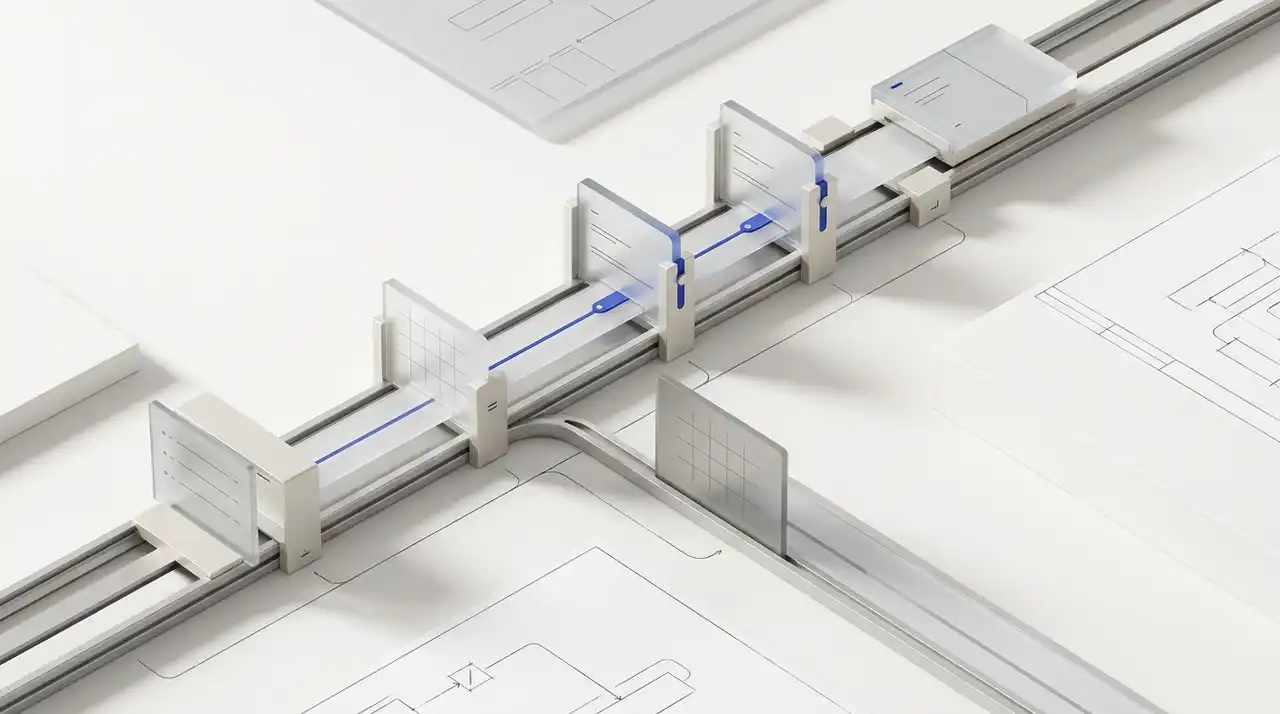
Approval gates work best when they are placed before irreversible actions, not after the output is already sent. The goal is to keep useful automation moving while making high-risk steps inspectable and reversible.
The Architecture of Trust: Moving Beyond the Chatbot
Most businesses start their AI journey with a chatbot. While useful for basic internal search, chatbots are reactive. The real business value lies in agentic workflows-systems that can reason through a problem, take an action in another software tool (like a CRM or ERP), and verify that the action was successful.
The NIST AI RMF Core gives teams a useful operating model: govern, map, measure, and manage risk across the AI lifecycle. For agentic workflows, governance is not a policy document sitting beside the product. It is the set of visible controls that decide when an agent may act, when it must stop, and what evidence a reviewer receives. Without a clear path for the AI to escalate uncertainty, the system becomes a liability rather than an asset.
Step-level execution logs
At Quellix Labs, our AI Agent Development service is built on the "operating loop" framework. This standardizes how an agent handles a task:
- Reason: The agent analyzes the input (e.g., a customer support ticket) and determines the necessary steps.
- Act: The agent executes a tool-use command (e.g., looking up a shipping status in a database).
- Verify: The agent checks its own work against the business rules before presenting a result.
If the "Verify" step fails-for instance, if the shipping data is missing or contradictory-the system shouldn't guess. It should trigger a fallback path to a human operator. This transition is where the ROI is actually realized: repeated low-risk work can keep moving while ambiguous or costly cases reach a human with the right context attached.
Workflow Implementation: Designing Approval Gates
Not every AI action requires a human signature. The key to a successful Operating Model is categorizing actions based on risk and certainty. We use a decision framework to determine where approval points must live.
1. The Extraction-to-Review Pipeline
In our AI Document Processing & Data Extraction service, we often build workflows for complex contracts or invoices. A "straight-through processing" model works for simple receipts, but for a 50-page Master Service Agreement (MSA), a human-in-the-loop is mandatory.
- The Build Path: The AI extracts key clauses (indemnification, termination, payment terms).
- The Approval Point: A legal analyst is presented with a side-by-side view: the original document text on the left and the AI's extraction on the right.
- The Outcome: The analyst verifies a focused evidence bundle instead of rereading the entire document. The AI handles repetitive extraction; the human handles judgment.
2. The Signal-to-Action Model
For Predictive Analytics & Recommendation Systems, the goal is often to drive sales or optimize inventory. If an AI predicts a high risk of churn for a key account, the "Action" shouldn't be an automated "We're sorry to see you go" email.
- The Build Path: The AI identifies the churn signal (e.g., lower product usage + missed support SLA).
- The Approval Point: A notification is sent to the Account Manager's Slack with a pre-drafted, personalized outreach email and a summary of the data.
- The Outcome: The AM clicks "Send" or "Edit," maintaining the relationship while benefiting from the AI's speed in identifying the risk.
The Fallback Framework: What Happens When the Model Fails?
The NIST AI RMF Playbook is intentionally voluntary and adaptable, which is the right posture for workflow controls. When an AI system reaches an uncertain or unsafe state, it needs a predefined exit strategy rather than an improvised guess.
Common Fallback Triggers:
- Low Confidence Scores: If a policy-defined confidence or evidence threshold is not met, the workflow routes to a human.
- Tool Failures: If an API call to your CRM times out or returns an error, the agent should log the state and notify a developer, rather than retrying indefinitely or hallucinating a success message.
- Policy Violations: If the agent's reasoning step detects a potential breach of company policy (e.g., offering a discount higher than the allowed 20%), the workflow freezes for management review.
By building these guardrails, you ensure that the AI is never the "final word" on high-stakes decisions. This structure allows you to scale the volume of tasks handled without scaling your headcount at the same rate.
Risks, Limits, and When to Wait
It is tempting to try and automate everything at once. However, there are specific scenarios where Quellix Labs advises clients to wait or keep the human involvement at 100%.
When Not to Build Full Autonomy:
- High-Stakes Compliance: If an incorrect data extraction could lead to a regulatory fine (e.g., GDPR or HIPAA violations), the human review stage cannot be optional. The AI serves as a "first pass" only.
- Nuanced Relationship Management: AI is excellent at data, but poor at politics. For high-value B2B sales negotiations, an AI agent should never communicate directly with the client without a senior leader reviewing the tone and context.
- Unstable Data Environments: If your underlying data (your Knowledge Base or CRM) is messy and unorganized, an AI agent will only accelerate the mess. Google's Secure AI Framework is a useful reminder that controls need to cover the system around the model. If the underlying knowledge base, CRM, or policy data is incomplete, automation accelerates the weakness instead of fixing it.
The Trade-off: Speed vs. Safety
Every approval point adds friction. If your goal is to respond to lead inquiries in under 30 seconds, a human approval point might be too slow. In these cases, we recommend a "review-gated execution" loop where the verification is done by a second, more constrained AI model specialized in safety, rather than a human. This maintains speed while adding a layer of automated oversight.
Decision Framework: Is Your Workflow Ready for AI?
Before investing in a custom build, founders and operators should evaluate their target workflow against these four criteria:
- Frequency: Is this a task done 100+ times a day? (High ROI for automation).
- Logic Consistency: Can you write down the rules for the task? (If you can't explain it to a human, you can't prompt an AI for it).
- Data Accessibility: Is the information needed to complete the task available in a digital, searchable format?
- Error Tolerance: What is the literal dollar cost of a mistake? (This determines the depth of the fallback path).
If a workflow is frequent, logical, and has accessible data, it is a prime candidate for an AI Agent Development project. The "Error Tolerance" then dictates how many human approval gates we build into the pipeline.
Moving from Pilot to Production
The difference between a successful AI implementation and a failed experiment is the AI Operating Standard. At Quellix Labs, we don't just deliver code; we deliver a governed system. This includes the monitoring tools to see how often the AI is hitting its fallback paths, allowing us to tune the prompts and tools over time to increase autonomy safely.
Building an AI system is an iterative process. You start with high human oversight, and as the system proves its reliability through the "Verify" step of the loop, you gradually widen the sandbox. This "Governed Pipeline" approach ensures that your business stays agile without sacrificing the brand reputation or operational stability you've worked hard to build.