Kimi K3 Adoption: Workflow Tests and Approval Gates
Draft for human review - not for publication.
Kimi K3 makes the open-weight enterprise model decision harder and more useful. Its announced scale, context capacity, vision support, and benchmark results suggest that open-weight models continue to narrow capability gaps with proprietary frontier models.
That conclusion needs careful boundaries. Moonshot's benchmark results are vendor-reported, while outside coverage describes strong frontier-level results without providing enterprise validation (Moonshot launch post; Axios coverage). Neither source establishes parity across a buyer's workflows, controls, latency targets, or cost profile.
The enterprise opportunity is therefore broader than choosing a high-scoring model. Kimi K3 creates another potential route to deployment control, portability, customization, inspectability, and lower vendor concentration. Those benefits only become real after the deployment path, license, artifacts, and operating model are verified.
When this needs an AI build
Move from model research to an implementation discussion when a workflow has measurable friction and repeated reasoning steps. The use case should require more than isolated prompting.
Good candidates include support investigations spanning account history and product documentation. Engineering work across several repositories may also qualify. Other candidates combine long documents, screenshots, and structured business records.
The case becomes stronger when employees repeatedly collect evidence, prepare a draft, request approval, and update another system. That sequence can become a bounded AI workflow with observable handoffs.
Kimi K3 is less relevant when deterministic rules or existing search already meet the requirement. It may also add little when an incumbent model meets quality, latency, and cost targets.
Define the operating change before selecting a deployment mode. A useful objective might be reducing support investigation time without increasing policy errors. Another might be improving code-change plans while preventing autonomous deployment.
Why the open-weight direction matters
Moonshot presents Kimi K3 as an open frontier model and reports 2.8 trillion total parameters. It identifies Kimi Delta Attention and Attention Residuals as architectural features (Moonshot launch post). These are vendor statements, not independent evidence of production performance.
The launch is still important for enterprise model strategy. Stronger open-weight models can create credible alternatives to a single proprietary API. They can also support routing decisions based on data class, task type, latency, cost, and operational control.
Open weights may improve model portability. A buyer could potentially move between compatible serving environments or customize the model for a narrow domain. Security and evaluation teams may gain more inspectability than a closed API permits.
These benefits are conditional. Open weights do not automatically provide an open-source license, complete training materials, safe deployment artifacts, or economical infrastructure. The term open-source should only be used after the released license and full artifact set justify it.
Moonshot announced July 27 as the target for releasing full weights (Moonshot launch post). As of this draft's July 17 review date, that target is still in the future.
Teams should not design a self-hosted production environment around an announced release alone. They should inspect the actual weights, license, model files, tokenizer, serving guidance, dependencies, security posture, and usage restrictions first.
What Moonshot announced - and what remains unproven
Moonshot positions Kimi K3 for long-horizon coding and knowledge work. Its launch materials provide vendor-reported benchmark results supporting that position (Moonshot launch post).
Those results are useful for shortlisting. They do not prove parity with proprietary frontier systems across enterprise tasks. Independent workflow testing remains necessary because benchmark scores rarely capture permissions, malformed inputs, tool errors, or reviewer effort.
Moonshot documents current K3 access and a one-million-token context window in its model materials (Kimi K3 quickstart). Its API overview provides the integration starting point for managed access (API overview).
K3 also supports vision inputs according to Moonshot's configuration guide (vision guide). This makes screenshots, diagrams, scanned pages, and mixed-media records relevant evaluation cases.
Vision support does not prove reliable extraction for every document class. Teams should test image quality, layout variation, handwriting, embedded instructions, and missing context.
Moonshot's earlier Kimi Linear repository offers background on its efficient-attention research (Kimi Linear repository). Research results should not be treated as measurements of K3's production API latency, throughput, or infrastructure cost.
Enterprise deployment paths
Kimi K3 creates three possible deployment paths. They offer different balances of speed, control, portability, and lifecycle ownership.
Proprietary or managed shared API
A managed API is the fastest path to a controlled pilot. The provider operates model serving, scaling, and much of the underlying infrastructure.
This path reduces initial platform work. It can also limit infrastructure visibility, regional choice, customization, and control over model updates.
Buyers should verify data retention, training use, processing regions, subprocessors, deletion controls, audit support, and versioning commitments. These details should be confirmed contractually for the intended data class.
Managed dedicated or private deployment
A dedicated or private deployment may offer stronger isolation, capacity guarantees, network controls, or regional placement. Availability and exact controls must be confirmed with the applicable provider.
This option can provide more deployment control without transferring the complete serving burden to the buyer. It may also support clearer data residency and performance planning.
However, "private" can mean several things. It may describe dedicated compute, a private network endpoint, isolated storage, or a provider-operated environment. Procurement and security teams should define the required boundary rather than relying on a label.
Self-hosted open-weight deployment
Self-hosting should enter the plan only after the weights, license, and supporting artifacts are released and reviewed. A successful technical proof does not settle licensing, security, or production readiness.
Self-hosting can provide the greatest control over data location, model versions, serving configuration, and customization. It can reduce dependence on one API provider and improve portability across approved infrastructure.
It also transfers lifecycle ownership. The enterprise becomes responsible for capacity, upgrades, security patching, evaluation, incident response, observability, and rollback.
A readable deployment comparison
Use the following framework before selecting a path.
Proprietary or managed shared API
- Best fit: Fast pilots and variable workloads.
- Control: Lowest infrastructure control.
- Data residency: Limited to documented and contracted provider options.
- Portability: Usually constrained by API behavior and provider features.
- Customization: Typically prompt, retrieval, tool, and supported tuning options.
- Operational burden: Lowest of the three paths.
- Primary risk: Provider concentration and limited deployment visibility.
Managed open-weight or dedicated deployment
- Best fit: Buyers needing isolation or regional options without full platform ownership.
- Control: Moderate, depending on hosting terms and model access.
- Data residency: Potentially stronger, but deployment-specific.
- Portability: Better when artifacts and serving interfaces remain transferable.
- Customization: Potentially broader than a shared API.
- Operational burden: Shared between the provider and buyer.
- Primary risk: Private deployment claims may exceed contractual guarantees.
Self-hosted open-weight deployment
- Best fit: Stable, high-value workloads with strict control requirements and mature infrastructure teams.
- Control: Highest control over data, versions, serving, and updates.
- Data residency: Determined by the enterprise's approved environment.
- Portability: Potentially highest, subject to license and infrastructure constraints.
- Customization: Broad, but every change requires validation.
- Operational burden: Highest by a significant margin.
- Primary risk: Infrastructure and lifecycle costs can overwhelm expected token savings.
Evaluation workflow and build path
A useful evaluation starts with one operating workflow and an incumbent baseline. Avoid a broad prompt contest without production outcomes.
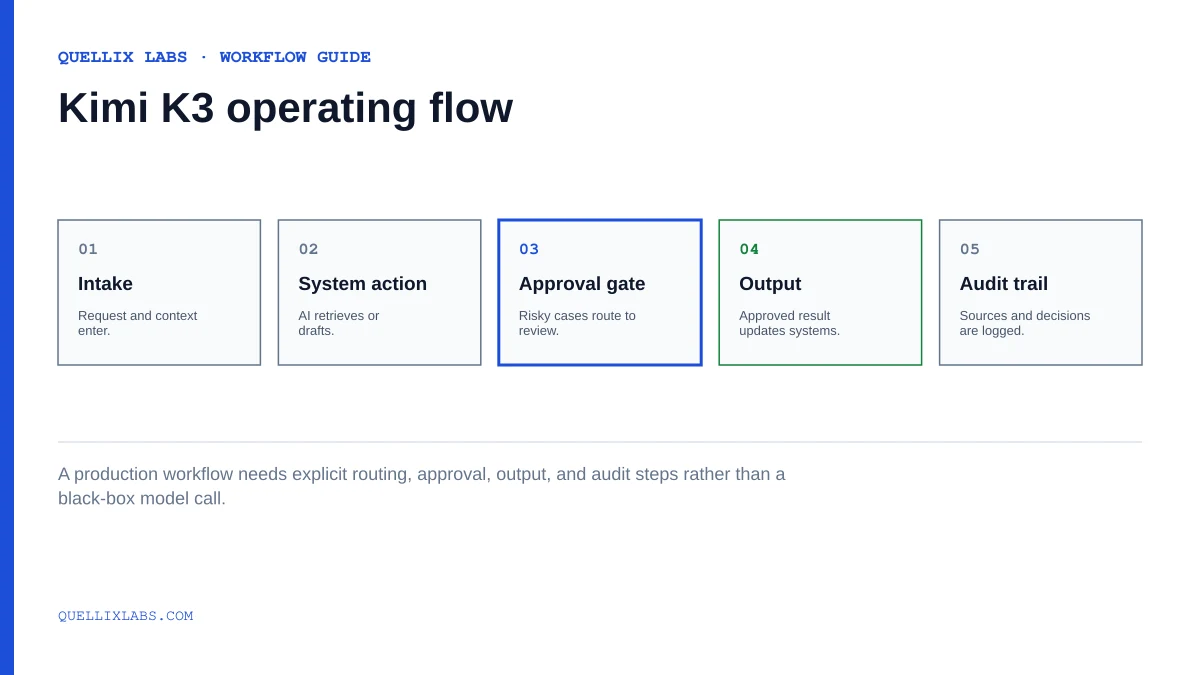
Kimi K3 operating flow
 Open the Pinterest-ready portrait graphic
Consider a support escalation workflow:
- Intake: Receive a ticket, account history, approved product material, and an optional screenshot.
- Retrieve: Select permission-aware evidence rather than sending every available record.
- Investigate: Identify the issue and draft a response with supporting references.
- Validate: Check evidence coverage, structured fields, policy conditions, and missing information.
- Approve: Route refunds, security issues, contractual language, and account changes to a support lead.
- Act: Send the response or prepare a CRM update only after the required approval.
- Record: Store inputs, evidence identifiers, output, reviewer decision, latency, cost, and disposition.
The fallback must be explicit. Conflicting evidence, uncertain permissions, tool failures, or missing sources should route the case to a person.
1. Freeze the baseline
Measure the incumbent model or manual process first. Record handling time, acceptance rate, corrections, escalations, cost per completed case, and user-visible latency.
Without a baseline, novelty can be mistaken for improvement.
2. Build a representative test set
Use controlled historical examples where appropriate. Include routine cases, long inputs, conflicting policies, malformed records, adversarial instructions, and required refusals.
Coding evaluations should include cross-file changes, failed tests, ambiguous requirements, and prohibited deployment actions. Knowledge evaluations should include stale and permission-restricted sources.
3. Score completed outcomes
Assess evidence accuracy, action accuracy, structured-output validity, correction effort, policy compliance, and fallback quality. Prose quality alone is insufficient.
A polished answer that writes an incorrect CRM field is a failed workflow result.
4. Compare context strategies
Test selected evidence, retrieval with moderate context, and a much larger context package. Treat the documented one-million-token window as a budget, not a document warehouse (Kimi K3 quickstart).
More context can increase cost and delay. It may also hide relevant evidence or expose material that the user cannot access.
5. Test model routing
Route cases by risk, modality, context requirement, and data class. K3 might handle long multimodal investigations while a smaller model handles classification.
Keep the incumbent available for fallback. This reduces migration risk and prevents a single model from becoming an unnecessary control point.
6. Run in shadow mode
Process live-shaped cases without allowing live actions. Compare K3 with the incumbent and record reviewer decisions.
Expand access only after results remain stable across task types, traffic periods, and failure conditions.
Governance and approval gates
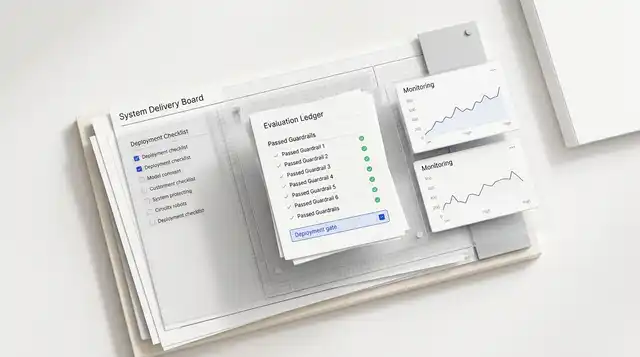
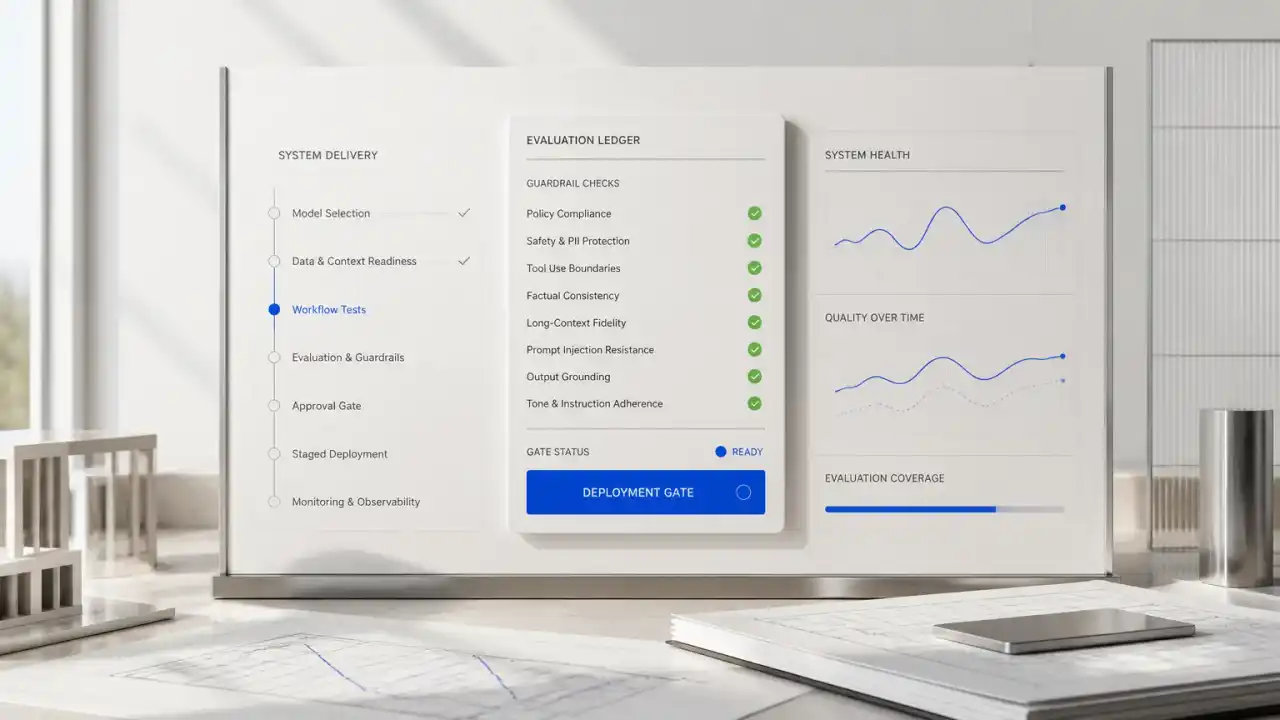
Place a data gate before each model request. It should determine which customer records, code, contracts, or images may cross the selected deployment boundary.
Use an evidence gate before an answer reaches a user. Require support from approved sources and reject outputs that cannot identify adequate evidence.
Use an action gate before refunds, CRM changes, outbound messages, code merges, or account updates. Low-risk actions can be reconsidered after sustained production evidence.
Add a release gate for model, prompt, retrieval, routing, or permission changes. Re-run the fixed evaluation suite whenever one of these components changes.
These controls keep adoption reversible. They also separate model errors from retrieval, tool, permission, and workflow failures.
Operational realities of open-weight deployment
A model with 2.8 trillion total parameters should not be assumed economical to self-host merely because weights are released. The parameter count is vendor-reported, and the production footprint will depend on the actual artifacts and serving configuration (Moonshot launch post).
Infrastructure planning must cover accelerator availability, memory, networking, storage, concurrency, and redundancy. Peak capacity matters more than average demand for user-facing workflows.
Quantization may reduce resource requirements, but it can change quality and behavior. Each quantized configuration needs evaluation against the production task set.
Serving expertise also matters. Teams need batching, queue management, caching, autoscaling, failure recovery, and version rollback. Observability must connect model behavior with workflow outcomes.
Security ownership expands after self-hosting. The enterprise must monitor dependencies, patch serving components, control artifact access, scan images, and respond to newly discovered weaknesses.
Lifecycle costs may outweigh token savings. Include engineering time, reserved capacity, idle hardware, evaluation, security work, upgrades, and incident response in the comparison.
Cost, latency, and data handling
Moonshot's pricing documentation is the starting point for current API charges (pricing documentation). A procurement estimate still requires observed usage from the intended workflow.
Track cost per completed task, not price per token or API call. One case may require retrieval, vision analysis, drafting, verification, and retries.
Measure latency end to end. Record median and tail latency for short, moderate, and very long inputs. Include retrieval, tool calls, approval delays, and fallback processing.
Before production use, confirm:
- whether submitted data is retained or used for model improvement;
- where prompts, images, and outputs are processed and stored;
- which deletion, access-control, and audit options apply;
- whether confidential fields can be redacted before transmission;
- which subprocessors and support personnel may access data;
- how model changes and deprecations are communicated;
- which terms cover customer data, confidential code, and generated output.
Public documentation is not a substitute for contract review. The required controls depend on the workflow's data classification and impact.
Risks and limits
Do not claim Kimi K3 matches proprietary frontier models without independent enterprise testing. Vendor benchmarks can justify evaluation, but not a production conclusion.
Do not call K3 open-source solely because weights are announced. Review the released license, restrictions, artifacts, dependencies, and documentation first.
Do not switch when the incumbent already meets operating targets. Migration introduces integration work, regression testing, monitoring changes, and staff retraining.
Wait when self-hosting is mandatory but the actual release has not been reviewed. Also wait when the workflow lacks agreed ground truth or a recoverable failure path.
Long context can create false confidence. It does not replace retrieval permissions, source freshness, evidence selection, or structured validation.
Vision support also introduces new attack and quality surfaces. Images may contain hidden instructions, sensitive details, poor scans, or misleading visual context.
Finally, avoid automating high-impact actions before rollback and approval mechanisms are mature. Model confidence should never be the only authorization signal.
Pilot decision framework
Set acceptance thresholds before the pilot. Otherwise, attractive examples can shift the decision rule.
Proceed only when K3:
- passes every critical permission and safety test;
- improves the selected workflow score by a material margin;
- meets latency targets at realistic context sizes;
- stays within the cost ceiling per completed task;
- satisfies data-handling and residency requirements;
- reduces reviewer effort instead of shifting work into correction;
- supports a tested route to another model or a human queue;
- remains stable after model, prompt, and retrieval variations.
The required margin should reflect migration and lifecycle costs. Any numeric threshold should be treated as an internal planning rule, not a universal benchmark.
Pause the pilot if a critical control fails. Continue evaluation when results are promising but sensitive to one task class, deployment configuration, or context strategy.
What Quellix would build
Quellix would begin in the AI adoption and optimization consulting context. The first deliverable would be a model-neutral evaluation harness tied to one production workflow.
The build would include a representative test set, scoring rubric, context variants, structured logs, cost tracking, latency measurement, approval gates, and fallback routing. K3 would run beside the incumbent before receiving action permissions.
Quellix would then evaluate the managed API, any supported dedicated deployment, and self-hosting readiness after artifact release. The assessment would cover data boundaries, portability, residency, capacity, security ownership, and total operating cost.
If the workflow uses tools, the implementation would move into enterprise AI agent development. Controlled actions might include CRM drafting, ticket classification, code-plan generation, or document review.
Permissions and approvals would be enforced outside the model. A routing layer would select models by task, risk, data class, and operating target.
The next step is a technical review of one workflow, its data boundaries, and its current baseline. That review can determine whether K3 merits a pilot and which deployment path deserves deeper diligence.