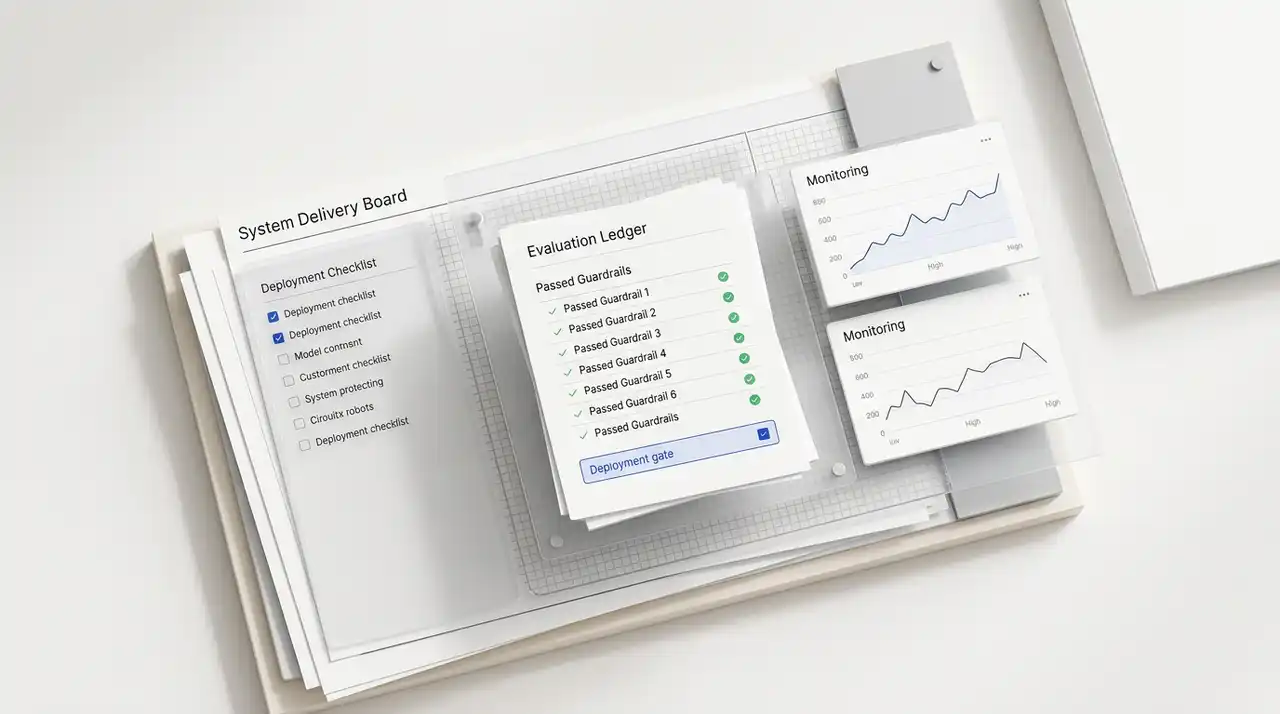
Grok 4.5 is relevant to enterprises when it can move a controlled workflow forward. The release-specific documentation should be the starting point for any capability review, rather than third-party summaries or benchmark commentary (SpaceXAI Grok 4.5 documentation).
That changes the buyer question. The issue is not whether Grok 4.5 can produce an impressive response. It is whether the surrounding system can control what the model reads, requests, changes, and reports.
For Grok 4.5 enterprise AI agents, model selection is only one design decision. Production value depends on permissions, tools, approvals, evaluations, audit records, and accountable owners.
When this needs an AI agent build
Grok 4.5 becomes an implementation candidate when a workflow needs action across systems. A support queue, release handoff, account research process, or finance exception path has inputs, policies, owners, and consequences.
A buyer should consider an AI agent build when four conditions apply:
- The work follows a repeatable path, even if some cases require judgment.
- Staff must collect information from several approved systems.
- The process has a measurable completion state and a named owner.
- Risky actions can stop for review before affecting customers or records.
Keep the model in an isolated pilot when those conditions are absent. A stronger model cannot repair unclear ownership, poor source data, or a process without an accepted outcome.
A conventional automation may also be enough. Use deterministic software when rules cover the task and inputs are predictable. Add a model when language interpretation, synthesis, or variable tool selection creates meaningful value.
What the Grok 4.5 release changes
The official Grok 4.5 page provides the current product-specific reference for evaluation (SpaceXAI Grok 4.5 documentation). Buyers should verify every required capability against that page and their own API tests before approving a design.
Function calling is especially relevant to agentic workflows. SpaceXAI documents a mechanism through which a model can work with developer-defined functions and tools (SpaceXAI function-calling documentation). That mechanism enables orchestration, but it does not create safe tool access by itself.
The application still decides which tools exist and which arguments are valid. It must also decide whether a requested action may execute automatically.
Structured outputs can support interfaces that expect machine-readable responses. SpaceXAI provides separate documentation for using structured output formats (SpaceXAI structured-outputs documentation). Schema compliance can improve integration reliability, but it does not prove that the underlying answer is correct.
These capabilities make Grok 4.5 worth testing for agent workflows. They do not remove the need for an operating boundary around the model.
Workflow: from model capability to operating system
Start with a real queue rather than a broad assistant concept. Customer support triage is one useful example because its inputs, decisions, and handoffs can be observed.
Grok 4.5 enterprise AI agents decision matrix
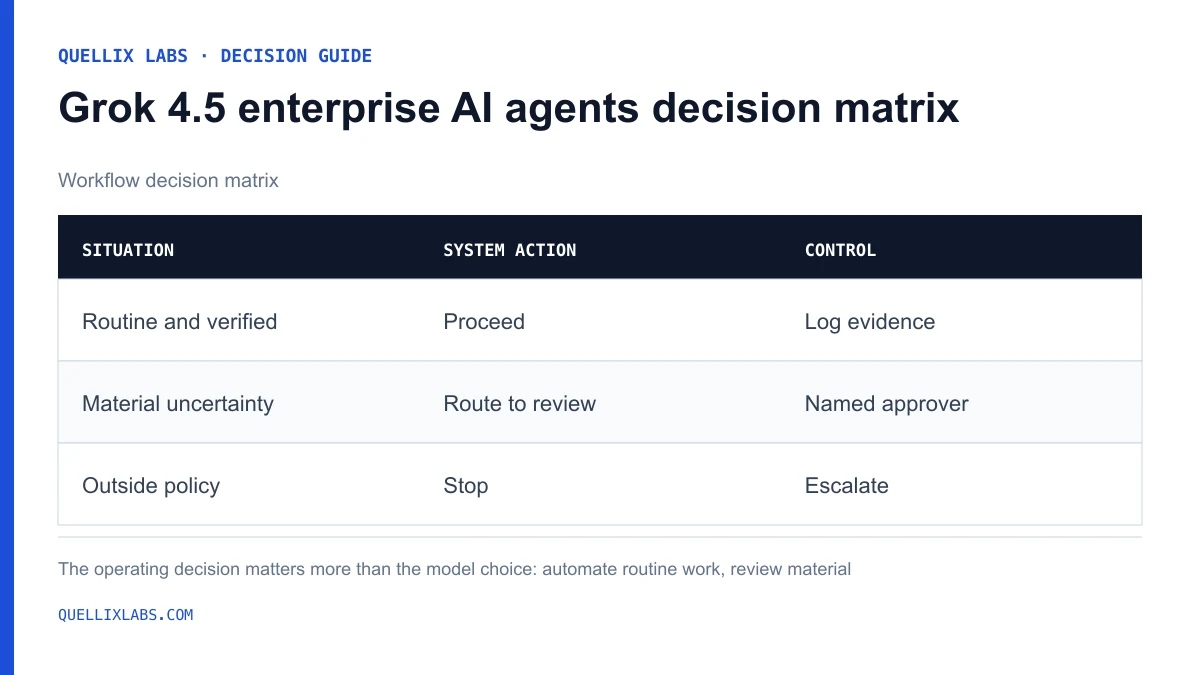
Read the data in this graphic
| Situation | System action | Control |
|---|---|---|
| Routine and verified | Proceed | Log evidence |
| Material uncertainty | Route to review | Named approver |
| Outside policy | Stop | Escalate |
A controlled workflow could follow this path:
- Receive: Capture the ticket, account identifier, product area, and service level.
- Authorize: Determine which sources and tools this case may use.
- Retrieve: Collect approved policies, relevant history, and current product information.
- Reason: Classify the request, identify missing facts, and propose the next action.
- Validate: Check required fields, tool arguments, policy conflicts, and source freshness.
- Approve: Pause when the action crosses a defined business or risk boundary.
- Execute: Perform only the approved tool call through a restricted service layer.
- Record: Store inputs, retrieved sources, decisions, tool results, and reviewer actions.
- Measure: Report completion, corrections, latency, cost, failures, and escalation reasons.
This sequence is the operating system around the model. It makes each transition visible and gives the team a place to enforce policy.
Crawlable workflow control map
- Intake: System control: Required-field validation; Evidence retained: Request and case identifier; Stop condition: Missing owner or invalid record.
- Retrieval: System control: Source and permission filters; Evidence retained: Source identifiers and timestamps; Stop condition: No approved source available.
- Model decision: System control: Prompt version and output schema; Evidence retained: Proposed action and rationale; Stop condition: Invalid structure or conflicting evidence.
- Tool request: System control: Tool allowlist and argument checks; Evidence retained: Tool name and validated parameters; Stop condition: Disallowed action or scope.
- Approval: System control: Role-based review; Evidence retained: Reviewer, decision, and time; Stop condition: Rejection or expired review.
- Execution: System control: Restricted service account; Evidence retained: Tool response and resulting state; Stop condition: Error, timeout, or unexpected result.
- Closure: System control: Completion validation; Evidence retained: Final status and correction history; Stop condition: Required outcome not confirmed.
The table is a reference architecture, not a vendor capability claim. Exact controls should reflect the workflow, data classification, and business impact.
Build path for a bounded first release
1. Define the workflow contract
Document the trigger, inputs, allowed sources, possible actions, and completion state. Name the person who owns exceptions and the team responsible for each connected system.
Do not begin with "automate support" or "create a research agent." Choose a narrower outcome, such as preparing a reviewed response for one support category.
2. Establish identity and access boundaries
Separate model access from tool authorization. A model request should not inherit broad employee permissions or an unrestricted integration token.
SpaceXAI publishes organization-management documentation for administrative configuration (SpaceXAI organization-management documentation). It also provides connector-management documentation that buyers can review when assessing connected data access (SpaceXAI connector-management documentation). Enterprise teams should map those provider controls to their own identity, logging, and separation-of-duty requirements.
3. Build tools as narrow business operations
Expose actions such as get_case_history, draft_response, or request_manager_review. Avoid generic tools that can run arbitrary queries or update unrestricted records.
Each tool should validate inputs independently. It should return explicit errors and use idempotency protection where duplicate execution could create harm.
4. Create the evaluation set before rollout
Use representative cases from the target workflow. Include successful examples, missing data, contradictory sources, duplicate requests, tool errors, and cases that must reach a person.
Evaluate the full path rather than the final text alone. Relevant measures include tool-selection accuracy, argument validity, unsupported claims, review outcomes, correction effort, latency, and cost per completed case.
5. Add approval and fallback paths
An approval should show the proposed action, supporting sources, model output, and expected consequence. The reviewer should be able to approve, edit, reject, or reassign the case.
Fallback behavior must also be explicit. A failed tool call might retry once, use a read-only alternative, or route the case to an owner. Silent looping is not an acceptable fallback.
6. Release in controlled stages
Begin with offline evaluation. Move next to shadow mode, where the system makes recommendations without acting. Then allow reviewed execution for a narrow group.
Broader automation should follow observed performance, not a launch date. Keep the model replaceable so the workflow can be retested against another provider or model version.
Decision framework and example thresholds
A scorecard prevents one impressive demonstration from becoming a production decision. It should cover quality, control, economics, operations, and user acceptance.
The thresholds below are hypothetical starting points. They are not Grok 4.5 benchmarks, guarantees, or universal standards.
- Valid tool arguments: Example pilot threshold: At least 98%; Why it matters: Invalid calls create failures and unsafe edge cases.
- Required human escalation: Example pilot threshold: At least 95% detected; Why it matters: The agent must recognize defined boundaries.
- Unsupported material claims: Example pilot threshold: Below 1%; Why it matters: Source-grounded work must remain inspectable.
- Duplicate write actions: Example pilot threshold: 0; Why it matters: Repeated execution can corrupt business state.
- Reviewer correction rate: Example pilot threshold: Below 15%; Why it matters: High correction effort can erase time savings.
- Completed-case cost: Example pilot threshold: Below the approved case budget; Why it matters: Token price alone does not represent workflow cost.
- Trace completeness: Example pilot threshold: 100% for executed actions; Why it matters: Every business action needs an inspectable record.
Teams should replace these examples with thresholds based on harm, baseline performance, and process economics. High-impact workflows may require stricter controls or no autonomous execution.
The best headline metric is usually reviewed completion. It shows whether the system finishes useful work within the accepted control model.
Risks and limits
Tool use can amplify errors
A fluent answer is reversible. A payment change, customer message, or record update may not be. Place consequential actions behind validation, narrow permissions, and approval.
More context does not ensure better context
Large context capacity can still contain stale, conflicting, irrelevant, or unauthorized material. Retrieval needs access filtering, source ranking, freshness rules, and a defined no-answer path.
Structured output is not factual validation
A response can match a schema while containing an incorrect value. Validate business facts against systems of record before execution.
Agent loops can hide operating cost
A single case may involve several model calls, retrieval steps, retries, reviews, and tool operations. Track cost per accepted outcome rather than model usage in isolation.
Provider controls do not replace enterprise controls
Buyers should examine the provider's current API security guidance during due diligence (SpaceXAI API security FAQ). They must still define internal requirements for access, retention, incident handling, vendors, and audit evidence.
Governance must follow the use case
The NIST Generative AI Profile offers a risk-management reference for organizations designing and governing generative AI systems (NIST Generative AI Profile). A production review should translate that guidance into controls tied to the specific workflow.
Do not build an agent when the process changes weekly, source systems have no owner, or no one can approve the risky step. Do not grant write access until allowed actions and recovery procedures are explicit.
What Quellix would build
Quellix would start with one bounded workflow and construct a reviewed action loop around it. The primary context is Enterprise AI Agent Development Services, supported by AI adoption consulting when provider selection, governance, or rollout planning remains unresolved.
The first release would include a workflow contract, permission map, narrow tool layer, evaluation set, source trail, approval interface, fallback paths, and operating dashboard. Grok 4.5 would remain a replaceable component within that architecture.
The implementation would move through five gates: workflow definition, offline evaluation, shadow operation, reviewed execution, and controlled expansion. Each gate would have named evidence and an accountable approver.
A technical review should begin with one workflow, sample cases, connected systems, and the action that carries the most risk. That is enough to define the first architecture and determine whether an agent build is justified.