
The ROI of Reliability: A Practical Framework for Evaluating AI Agent Performance
Most enterprise AI initiatives stall in the same place: the gap between a successful demo and a reliable production system. It is easy to build a prototype that handles a single, happy-path customer query. It is significantly harder to build an agentic workflow that handles 10,000 queries across edge cases, API timeouts, and ambiguous user intent without escalating costs or hallucinating facts.
For founders and operators, the decision to greenlight an AI build should not be based on model benchmarks or general excitement. It must be based on a rigorous evaluation of the specific workflow the agent is intended to own. If you cannot measure the reliability of the agent, you cannot calculate its ROI.
At Quellix Labs, we view AI agent evaluation not as a one-time test, but as a continuous operating standard. This guide outlines how to determine if your AI workflow is ready for production and the architectural choices that ensure it stays there.
When this needs an AI build
Before diving into evaluation metrics, you must determine if your business problem actually warrants a custom AI agent. Many processes are better served by deterministic code, simple automation, or standard heuristics. A custom AI agent build is justified when your workflow meets specific criteria:
- High Semantic Complexity: The workflow requires interpreting unstructured, ambiguous, or multi-modal data that traditional rules-based engines cannot parse.
- Dynamic Tool Orchestration: The system must autonomously decide which APIs, databases, or external tools to call based on real-time user inputs.
- Variable Execution Paths: The process cannot be mapped to a static decision tree, requiring the system to reason through novel edge cases dynamically.
- High-Volume Information Bottlenecks: Human operators are spending critical hours manually reading, synthesizing, and moving data between disparate enterprise systems.
If your workflow is highly predictable and relies on structured data, a traditional software integration is more cost-effective. If it requires semantic reasoning, dynamic tool usage, and adaptive decision-making, a custom AI agent build is the correct path.
The Evaluation Gap: Why General Benchmarks Fail Business Workflows
In the research world, models are judged on benchmarks like MMLU (Massive Multitask Language Understanding). While these scores indicate general intelligence, they are nearly useless for a B2B leader deciding whether an agent should handle contract renewals or support triage.
General benchmarks do not account for your specific data, your API constraints, or your compliance requirements. A model might be in the 99th percentile for logic but fail consistently at extracting a specific date format from your legacy ERP system.
To bridge this gap, evaluation must move from "general intelligence" to "workflow fidelity." According to the NIST AI Risk Management Framework, trustworthy AI must be valid, reliable, and safe. In a commercial context, this means the agent must perform the same task correctly under varying conditions, and it must fail gracefully when it encounters a scenario outside its instructions.
+-----------------------------------------------------------------+
|                    THE AGENTIC TRIANGLE                         |
|                                                                 |
|                           ACCURACY                              |
|                          /                                     |
|                         /                                      |
|                        /                                       |
|                       /                                        |
|                      /                                         |
|               LATENCY ----------------- COST                    |
|                                                                 |
|  Optimizing one vector inevitably degrades the other two.       |
+-----------------------------------------------------------------+
The Implementation Framework: Review-Gated Execution
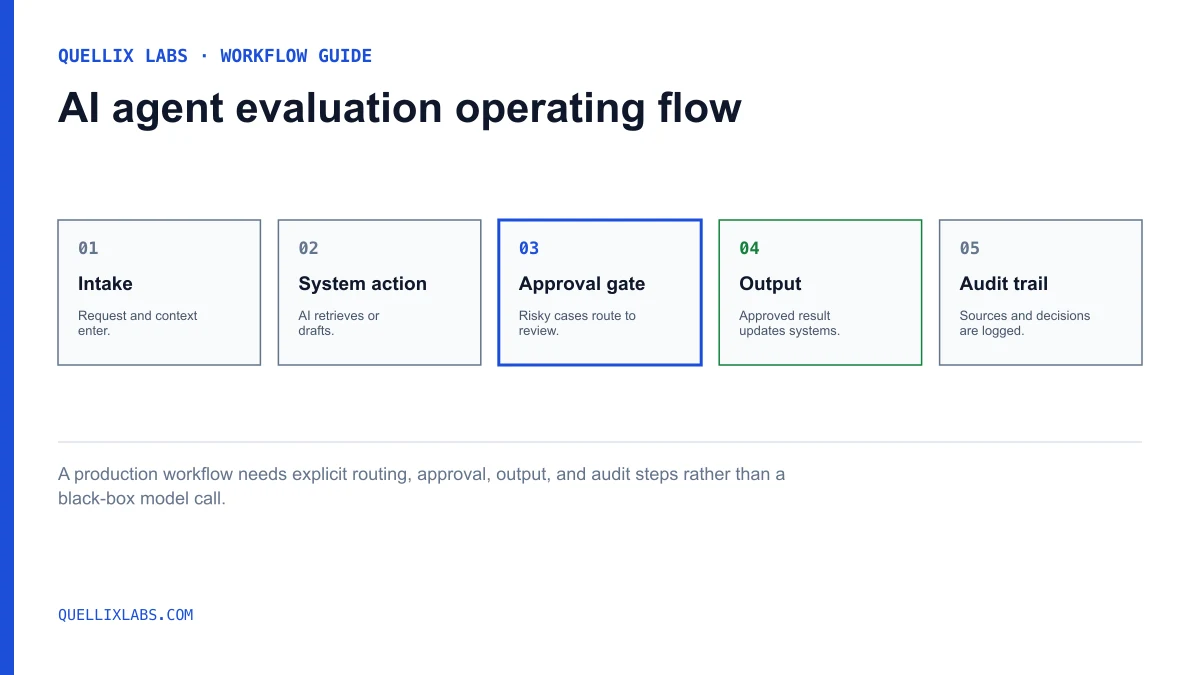
To evaluate an agent effectively, you must first structure its behavior. We utilize the "operating loop" framework: Reason, Act, and Verify. This structure creates natural checkpoints for evaluation.
AI agent evaluation operating flow
 Open the Pinterest-ready portrait graphic
- Reason: The agent analyzes the input and determines the necessary steps. Evaluation here focuses on "Intent Accuracy." Did the agent understand what the user wanted?
- Act: The agent executes a tool or calls an API. Evaluation here focuses on "Tool-Call Precision." Did it pass the correct parameters to the CRM or database?
- Verify: The agent checks its own output or the result of the action against the original goal. Evaluation here focuses on "Output Grounding." Is the final answer supported by the facts retrieved?
By breaking the workflow down, you can identify exactly where a system is failing. If the agent is failing at the "Act" stage, the problem is likely a brittle API integration, not a lack of reasoning capability in the model.
Concrete Workflow: Automated Renewal Risk Detection
Consider a common B2B challenge: identifying customers at risk of churn before the renewal date.
- Illustrative input: The system ingests product-usage changes, support-ticket sentiment, and CRM notes. Each team defines the change thresholds and time windows that matter for its retention workflow.
- The System Action: An AI agent reasons through this data. It doesn't just look for keywords; it identifies patterns. It might note that while usage is down, the support tickets were related to a specific feature rollout that has since been fixed. It then calculates a risk score and drafts a summary for the Account Manager.
- Human Approval Point or Fallback: If the risk score exceeds a team-defined threshold, the agent does not act autonomously. Instead, it triggers a task in the CSM's dashboard with the drafted summary and the supporting evidence. If the data is missing or corrupted, the system triggers a fallback to alert a data engineer instead of providing a hallucinated risk score.
- Evaluation target: Focus CSM review on accounts with visible risk evidence while measuring false positives, missed risks, review time, and retention outcomes during the pilot.
Building for Observability: Beyond the Black Box
One of the primary reasons AI builds fail is a lack of visibility. When an agent makes a mistake, developers often treat it as a mystery to be solved by "prompt engineering." This is a mistake.
Modern AI evaluation requires technical observability. We recommend using standards like OpenTelemetry to track every step of an agent's reasoning process. By capturing traces of the agent's internal logic, you can see exactly where a hallucination started or where an API call timed out.
This level of detail is critical for building observability for agentic AI systems. Without it, you are flying blind, and your ability to improve the system over time is limited to guesswork.
The Decision Framework: When to Build vs. When to Wait
Not every workflow should be automated with AI. As a senior advisor, I often tell clients that the most expensive way to solve a simple problem is with a complex AI agent.
When to Build:
- High Volume, Low Complexity: Tasks that are repetitive but require some level of semantic understanding (e.g., categorizing thousands of support tickets).
- Information Bottlenecks: When a human is required only to move data from one system to another (e.g., updating a CRM based on a recorded sales call).
- Time-Sensitive Decisions: When a delay in response costs money (e.g., modernizing fraud scoring).
When to Wait (or Not Build):
- High Error Costs with No Human Loop: If an agent making a 1% error could lead to a catastrophic legal or financial event, and you don't have the resources for a human-in-the-loop, do not build it yet.
- Low volume: If measured recurring handling cost is lower than the cost to build, evaluate, and maintain an agent, keep the simpler process.
- Unstructured Data with No Source of Truth: AI agents excel at reasoning over data, but they cannot invent data that doesn't exist. If your internal documentation is a mess, start with building private enterprise AI search before trying to build an autonomous agent.
Trade-offs: Cost, Latency, and Accuracy
In AI engineering, you can rarely optimize for all three. This is the "Agentic Triangle."
- Accuracy: Higher field-level accuracy and stricter verification can require additional model calls and checks, increasing cost and latency. Set the target from the risk of each action.
- Latency: If you need a response in under 500ms, you may have to use a smaller, faster model that might sacrifice some reasoning depth.
- Cost: Using the most powerful models (like GPT-4o or Claude 3.5 Sonnet) for every simple task will quickly erode the ROI of the project.
Evaluating an agent means deciding which of these three you are willing to trade. For an internal research tool, latency might not matter. For a customer-facing chat agent, latency is everything.
The Role of Durable Execution
One technical lesson that business leaders often overlook is the concept of "Durable Execution." AI agents often interact with external APIs that are unreliable. If an agent is in the middle of a 10-step workflow and step 7 fails because a server is down, what happens?
In a standard script, the whole process fails, and the data is lost. In a professional build, we use orchestration engines like Temporal. These tools ensure that if a step fails, the state is preserved, and the agent can resume exactly where it left off once the service is back online. This is the difference between an AI that works in a lab and AI agents that actually finish the job.
Risks, Limits, and Edge Cases
While agentic workflows offer immense business value, they introduce unique engineering risks that must be managed:
- Cascading Failures: In multi-agent systems, an error in the output of Agent A can propagate and amplify as it passes to Agent B, leading to unpredictable system behavior.
- State Bloat and Memory Decay: Long-running agents accumulate context over time. Without strict memory pruning, token costs rise exponentially and the model's attention span degrades.
- Infinite Loops: If an agent is designed to self-correct, a persistent tool failure can trap the agent in an infinite loop of retries, incurring massive API costs in minutes.
- Prompt Injection and Tool Exploitation: If user inputs are passed directly to tools without strict validation, malicious actors can hijack the agent's execution path to access unauthorized data.
What Quellix Would Build
When partnering with enterprise clients, Quellix Labs designs and deploys production-grade agentic systems through our AI Agent Development service. We do not build fragile wrappers; we build resilient, stateful systems engineered for enterprise scale.
+-----------------------------------------------------------------+
|                QUELLIX AGENTIC ARCHITECTURE                     |
|                                                                 |
|   [User Input]                                                  |
|        |                                                        |
|        v                                                        |
|   +----------+      Traces      +---------------------------+   |
|   |  Reason  | ---------------> |  OpenTelemetry Collector  |   |
|   +----------+                  +---------------------------+   |
|        |                                                        |
|        v                                                        |
|   +----------+      State       +---------------------------+   |
|   |   Act    | ---------------> | Durable Execution Engine  |   |
|   +----------+                  |        (Temporal)         |   |
|        |                        +---------------------------+   |
|        v                                                        |
|   +----------+                                                  |
|   |  Verify  |                                                  |
|   +----------+                                                  |
|        |                                                        |
|        v                                                        |
|   [Human-in-the-Loop Gate]                                      |
+-----------------------------------------------------------------+
Our standard build path includes:
- Stateful Orchestration Layer: We implement Temporal to guarantee that long-running agent workflows are entirely fault-tolerant and crash-proof.
- Semantic Guardrail Pipeline: We deploy real-time input and output validation layers to block prompt injections and catch hallucinations before they reach users.
- Unified Observability Stack: We instrument the entire agentic loop with OpenTelemetry, giving your engineering team complete visibility into execution traces, cost per run, and latency bottlenecks.
- Human-in-the-Loop (HITL) Dashboards: We build custom administrative interfaces that allow your team to review, edit, and approve high-risk agent actions before they execute.
Grounded Next Steps for Buyers
If you are currently evaluating an AI agent project, avoid the temptation to start with a "Proof of Concept" that has no success metrics. Instead, follow these three steps:
- Define the "Unit of Work": What is the exact input and the exact desired output? Avoid broad goals like "improve productivity."
- Calculate the Cost of an Error: If the agent gets it wrong, what happens? Use this to determine if you need a human-in-the-loop or a more robust verification step.
- Audit Your Data Infrastructure: Does the agent have access to the "Cited Knowledge" it needs to make accurate decisions? If not, your first project isn't an agent; it's a knowledge base.
Building AI that works in production is a matter of engineering discipline, not magic. By focusing on workflow fidelity, durable execution, and rigorous evaluation, you can move past the hype and build systems that deliver measurable business value.
Related Reading
- Durable Execution: The Architecture of AI Agents That Actually Finish the Job
- Beyond the Black Box: Building Observability for Agentic AI Systems
- Designing Governance into AI Workflows: Approval Points and Fallback Paths
- Scaling B2B Revenue With Agentic Workflows: From Copilot Help to Governed Pipeline Action