Why Step-Level Logging is Essential for Reliable AI Agents
When an AI agent fails in a laboratory setting, it is a curiosity. When it fails in a production B2B environment, it is a liability. For founders and operators, the biggest hurdle to deploying AI agents isn't just getting them to work once; it is understanding why they fail when they do.
Traditional software logging tells you if a server is up or down. But AI agents are non-deterministic. They can be "up" and still provide a completely wrong answer or execute an incorrect action. To solve this, leadership teams must move beyond basic error logs toward agentic observability. This approach uses step-level logging and standardized tracing to turn the "black box" of AI into a transparent, auditable business process.
The Ghost in the Machine: Why Standard Logs Fail
Most legacy systems log events like "User Logged In" or "Database Updated." These are binary outcomes. In contrast, an AI agent operates through a series of internal hops. It might search a knowledge base, reason through the results, decide to call a tool, and then format a response.
If the final output is wrong, a standard log only shows the failure at the finish line. It doesn't tell you if the search query was poor, the reasoning was flawed, or the tool returned corrupted data. Without step-level logging, your engineering team is forced to play a guessing game, burning expensive developer hours on "prompt engineering" that may not even address the root cause.
At Quellix Labs, we treat every agentic action as a trace. By implementing agentic observability, we capture the intent, the context, and the outcome of every sub-step. This transparency is what allows a sales leader to trust an agent with CRM updates or a product head to deploy a support triage bot to thousands of customers.
The Architecture of Observability: Spans and Traces
To build a reliable agent, you must adopt the standards of distributed tracing. In this model, an agent's journey is broken down into "spans." A span represents a single unit of work, such as an LLM completion request or a database lookup. A "trace" is the collection of these spans that tells the story of a single request from start to finish.
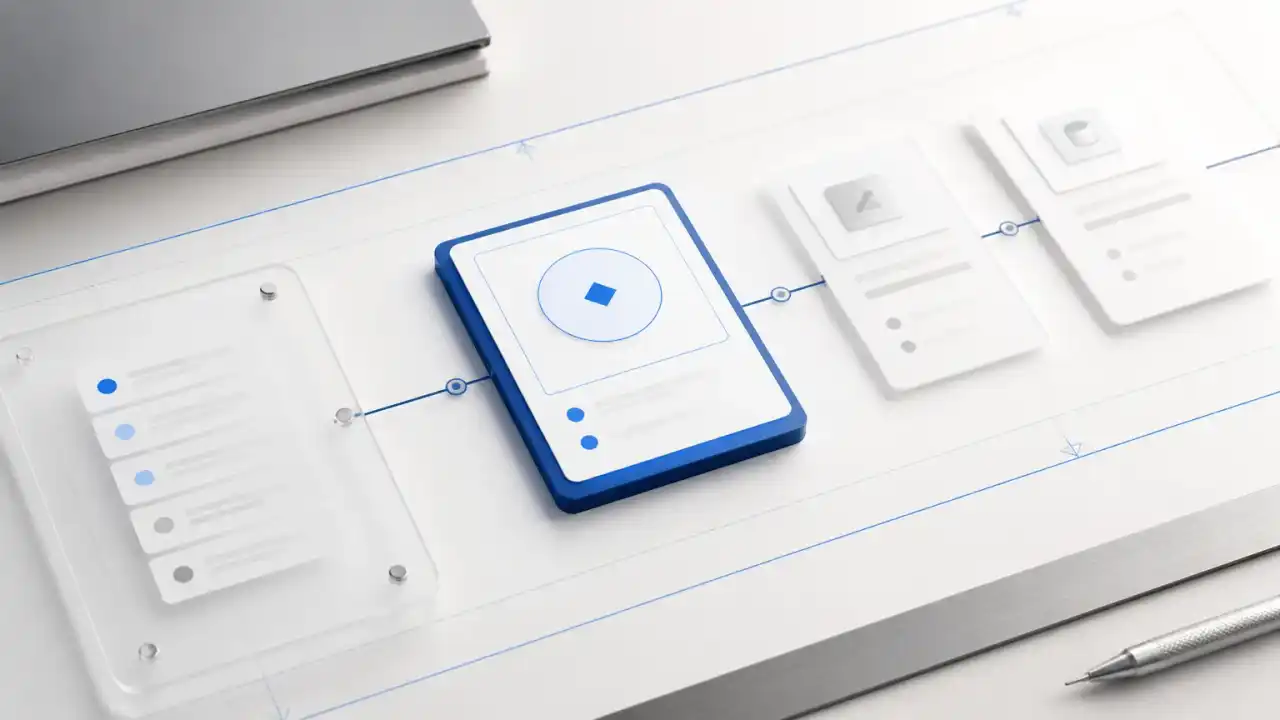
Step-level execution logs
In our AI Agent Development service, we utilize the "operating loop" framework. Observability is the nervous system of this loop:
- Reason: The agent interprets the user's intent. Observability logs the exact prompt and the model's internal "chain of thought."
- Act: The agent interacts with a tool, such as a CRM or an ERP. Observability captures the API call and the raw response.
- Verify: The system checks if the action was successful. Observability records the validation logic and any retry attempts.
By following OpenTelemetry standards, we ensure that these logs are not trapped in a proprietary vendor format. They can be piped into your existing enterprise monitoring stack, whether you use Google Cloud, Azure, or specialized observability platforms. This is critical for maintaining a "Cited Knowledge Loop" where every decision an agent makes can be traced back to a specific piece of source data.
Workflow Implementation: The Support Triage Agent
Consider a support triage agent designed to handle incoming technical tickets. Without observability, a ticket that is misrouted is a mystery. With step-level logging, the build path looks like this:
- Input: A customer submits a ticket about a "sync error" in their dashboard.
- Step 1 (Reasoning): The agent identifies the core issue as a data integration failure. Log: Sentiment analysis and intent classification spans.
- Step 2 (Knowledge Retrieval): The agent queries the internal documentation for "sync error codes." Log: The exact search query and the snippets retrieved from the vector database.
- Step 3 (Tool Use): The agent checks the customer's account status in the CRM. Log: API request/response with timestamps.
- Step 4 (Verification): A human operator or a secondary "judge" model reviews the proposed resolution. Log: Approval status and any modifications made by the human.
- Outcome: The ticket is routed to the Integration Team with a pre-drafted summary, reducing time-to-resolution by 40%.
If the agent had incorrectly routed the ticket to the Billing Team, the logs would show exactly where the logic diverged. Perhaps the knowledge retrieval step returned a billing document by mistake. This level of detail allows for surgical fixes rather than broad, ineffective prompt changes.
Durable Execution and State Visibility
For agents that run for hours or days-such as those managing long-term lead research or inventory replenishment-observability must include "state." If an agent is interrupted mid-task, it needs to know where it left off.
We utilize durable execution frameworks to ensure that every step of an agent's workflow is persisted. This provides a "flight recorder" for your AI. If a system crashes, the agent resumes exactly at the last successful span. This reliability is non-negotiable for enterprise-grade automation. When you can see the state of every running agent in real-time, you move from reactive troubleshooting to proactive management.
Decision Framework: When is High-Level Observability Overkill?
Not every AI implementation requires deep, step-level tracing. Founders should evaluate the need based on two factors: complexity and consequence.
When to Build Simple Logs
- Low Complexity: A simple script that summarizes a single document once and provides the output to a user who can immediately verify it.
- Low Consequence: A creative brainstorming tool where a "bad" answer has zero impact on business operations or data integrity.
When to Invest in Agentic Observability
- High Complexity: Workflows involving multiple tool calls, long-running loops, or multi-agent collaboration.
- High Consequence: Any agent that writes data to a system of record (CRM, ERP), interacts with customers, or handles regulated data.
- Audit Requirements: If your industry requires a clear audit trail of how decisions were reached (e.g., Finance, Healthcare, Legal).
Risks, Limits, and Trade-offs
While observability is a superpower, it comes with specific trade-offs that buyers must consider.
- Latency Overhead: Adding detailed logging and tracing can add milliseconds to every step. In high-frequency trading or real-time voice applications, this might be a dealbreaker. However, for most B2B workflows, the 50ms trade-off is worth the gain in reliability.
- Storage Costs: Step-level logging generates a massive amount of data. If you are running millions of agentic steps a day, your observability bill can rival your inference bill. We recommend implementing retention policies that aggregate old logs while keeping detailed traces for recent or failed transactions.
- Data Privacy: Detailed traces often capture PII (Personally Identifiable Information) within the prompts and responses. It is vital to implement redaction layers before logs are sent to a third-party observability provider. This ensures compliance with GDPR, CCPA, and internal security policies.
The Strategic Build: Moving Toward Production
For B2B leaders, the goal is not to build the "smartest" agent, but the most predictable one. Predictability is a product of visibility. When you can measure the success rate of individual steps-not just the final output-you can iteratively improve your system with scientific precision.
If you are currently running an AI pilot and find yourself saying "it usually works, but sometimes it goes off the rails," you don't have a prompt problem. You have an observability problem. Implementing OpenTelemetry-compliant tracing is the first step toward turning that pilot into a robust, revenue-generating asset.
At Quellix Labs, we don't just build agents; we build the infrastructure that makes those agents manageable. By integrating step-level logging into the operating loop, we provide the transparency needed for true enterprise adoption.
Related Reading
- The ROI of Reliability: A Practical Framework for Evaluating AI Agent Performance
- Durable Execution: The Architecture of AI Agents That Actually Finish the Job
- Designing Governance into AI Workflows: Approval Points and Fallback Paths
- Engineering Reliable Sales Agents: A Decision Framework for B2B Leaders