Choosing an AI Agent Development Company for ROI
Most enterprise leaders are tired of chatbots that simply talk. In 2026, the priority has shifted from "What can AI say?" to "What can AI do?"
This shift marks the transition from basic generative AI to agentic systems. These are software programs that can reason, use tools, and complete multi-step workflows without constant human hand-holding.
Choosing an AI agent development company is no longer about finding the best prompt engineers. It is about finding a partner who understands the "operating loop."
Agentic systems move AI from passive assistance toward controlled execution across tools. The useful buyer question is whether that execution can be bounded, reviewed, and audited in the target workflow.
Choosing an AI agent development company
Choose an AI agent development company by looking at the workflow it can safely automate, not by comparing demos. Strong partners should explain tool access, approval gates, fallback behavior, monitoring, integration depth, and how ROI will be measured after launch.
If a vendor cannot show how the agent handles retries, permissions, human review, and operational exceptions, the project is still a prototype risk even if the demo looks polished.
The Shift from Chat to Agency
A traditional chatbot waits for a prompt and provides a text response. It is a reactive tool that lives within a single window.
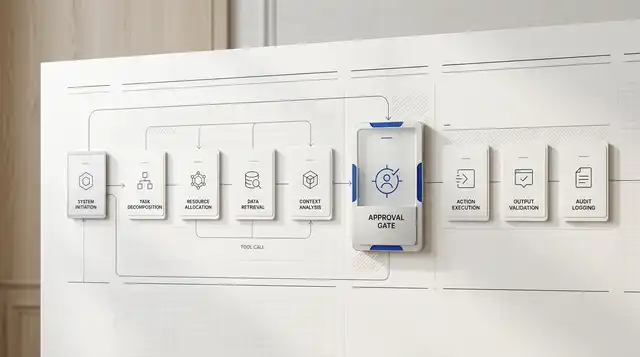
An AI agent operates within a approval-and-verification workflow. It doesn't just answer a question about a customer's billing history; it takes action.
For example, an agent can log into a billing portal and identify a discrepancy. It then drafts a correction and asks a human for approval before hitting "send."
As Anthropic notes, the value is no longer in the model itself. The value lies in the orchestration of that model across your existing software stack.
The ROI of Middle-Office Automation
Leaving high-volume, repetitive workflows to manual labor is a speed tax. It slows down growth and increases the likelihood of human error.
When a sales lead waits six hours for a response, the lead cools. When a support ticket bounces between departments, customer satisfaction drops.
An AI agent development company focuses on identifying these "bottleneck workflows." These are tasks where the steps are clear but the human time required is high.
By automating these, you aren't just saving money. You are increasing the throughput of your most expensive employees.
The operational case for an agent must be measured in the target workflow against the current baseline; a generic efficiency percentage is not a defensible substitute for that evaluation.
The Build-Path: Engineering an Automated Procurement Agent
To understand what a professional build looks like, let's examine a specific workflow. We will look at an Automated Procurement Agent designed for a mid-market manufacturing firm.
Step 1: Tool Definition and API Mapping
The first step is defining what the agent can actually "touch." We map the APIs for the ERP system, the vendor database, and communication tools.
Each tool is given a strict schema. This ensures the agent knows exactly what data to send and what to expect in return.
We avoid "loose" prompts. Instead, we use structured output to ensure the agent interacts correctly with legacy systems.
Step 2: State Machine Design
Agents need a memory of where they are in a process. We design a state machine that tracks the progress of a procurement request.
If the agent is waiting for a vendor quote, it enters a "Pending" state. It does not move to "Analysis" until the data is received.
Using frameworks like LangGraph, we ensure the agent can handle interruptions. It can resume its task even after a system reboot.
Step 3: Reasoning and Decision Logic
We use high-reasoning models to evaluate vendor quotes against historical data. The agent is programmed to look for specific red flags.
For instance, it might flag price increases above 5% compared to the previous quarter. This is where the "Reasoning" happens.
The agent isn't just copying data. It is evaluating it against business rules defined by your procurement experts.
Step 4: Human-in-the-Loop (HITL) Integration
No enterprise agent should operate in a vacuum. We build specific "Approval Gates" into the workflow.
For any purchase over $5,000, the agent automatically pauses. It generates a summary of its findings and sends a notification to the manager.
The manager provides a one-click approval or rejection. This maintains human oversight while removing the manual data entry burden.
Step 5: Evaluation and Optimization (Evals)
Before deployment, we run the agent through hundreds of historical scenarios. We measure its accuracy against past human decisions.
This "Eval" phase is critical. It ensures the agent behaves predictably before it ever touches live production data.
We track metrics like "Tool Call Accuracy" and "Reasoning Consistency." This data informs the final prompt tuning and model selection.
Technical Architecture: Beyond the Prompt
Building an agent that works in a demo is easy. Building one that works at scale is difficult.
Reliable agents require three core components that most "wrapper" companies ignore. These components ensure the system is durable and observable.
1. Durable Session Layers
If a cloud server restarts during a 10-step task, does the agent start over? A professional build uses durable sessions.
This allows the agent to remember exactly where it left off. It is essential for long-running tasks like multi-day research projects.
2. Step-Level Logging and Observability
You cannot debug a "black box." High-quality agentic systems log every thought, action, and tool output.
This allows your technical team to see exactly why an agent made a specific decision. It is the foundation of enterprise compliance and security.
3. Cost-Aware Model Routing
Not every task requires a flagship model. A smart implementation routes simple tasks to smaller, cheaper models.
It reserves high-reasoning models for complex decision-making. This keeps your operating costs sustainable as you scale across the organization.
Implementation Risks and Limits
Not every problem should be solved with an AI agent. Automation is not a magic wand for broken processes.
If your data is siloed or messy, an AI agent will only fail faster than a human. You must address data extraction and processing before deploying agents.
High-Stakes Errors
If an error could result in physical harm or significant legal liability, the technology is not ready for full autonomy. Always keep a human in the loop for high-stakes decisions.
The Infinite Loop Risk
Poorly designed agents can get stuck in "reasoning loops." They might call an API repeatedly without making progress.
This can lead to massive cloud bills in a matter of hours. We prevent this by implementing "Max Step" limits and budget caps at the infrastructure level.
Data Privacy in Multi-Agent Systems
When agents talk to other agents, data can leak across boundaries. It is vital to implement strict data masking.
Every agent in the ecosystem should have its own permission set. This follows the principle of least privilege.
Decision Framework: Build vs. Buy vs. Partner
For most leaders, the choice is between buying a generic SaaS tool or partnering with an AI agent development company.
Generic tools are cheaper upfront. However, they often lack the deep integration needed for complex, proprietary workflows.
A custom build creates a competitive advantage. You own the workflow, the data remains in your environment, and the system is tuned to your specific needs.
Companies using custom agentic orchestration see significantly higher efficiency gains than those using off-the-shelf features. This is because custom agents are built around your unique business logic.
The Path Forward: Start with a Technical Review
If you are deciding whether an AI system is worth building, start with the "Pain vs. Frequency" matrix. Look for tasks that are high-pain and high-frequency.
These are your best candidates for an initial pilot. Do not try to automate your entire company at once.
At Quellix Labs, we recommend starting with a Technical Review of a single workflow. This allows you to prove the ROI before committing to a full-scale rollout.
The goal is to move from manual friction to "Agentic Leverage." This is where your team focuses on strategy while the agents handle the execution.