Permission-aware RAG retrieves only the documents an employee may see, then uses those passages to answer with citations. Access checks belong before restricted text reaches the model. A filter on the final answer cannot undo a disclosure that already happened inside the system.
Consider a simple question: "Can I buy a monitor for my home office, and who approves it?" The answer may depend on location, employment type, the current equipment policy, and an approval table. The assistant needs those facts without pulling in a private accommodation record or a manager-only exception memo. This is an illustrative employee-support scenario, not a client case study.
When this needs an AI build
Start with one support domain where repeated questions have documented answers and a named owner. IT troubleshooting, equipment requests, and procurement procedures are useful candidates when employees currently search several systems or open a ticket just to find a policy.
Check the existing search product before commissioning a new assistant. If staff mainly need better bookmarks, current documents, or a clearer portal, those improvements may solve the problem. A custom RAG layer becomes more useful when the answer must combine permitted evidence across systems and explain how it applies to the requester's situation.
Permission differences make the engineering more demanding. Confirm that each proposed connector exposes stable document identifiers, access rules, and update signals. If it cannot, limit the pilot to sources whose boundaries can be enforced. A broad export of company files is a poor substitute for a permission-aware connector.
What changes when retrieval works well
A conventional intranet asks an employee to choose the right portal, search with the right wording, open several documents, and judge which one is current.
A well-designed RAG experience changes that sequence. The employee asks a normal question. The system searches permitted sources, ranks relevant passages, and returns a concise answer with links to the underlying material.
Enterprise search products commonly combine indexing, search experiences, and organization-specific content discovery. Microsoft describes Microsoft Search as a way to find information across an organization's content and services (Microsoft Learn). Microsoft also documents search access through Microsoft Graph, which can support applications that need to query enterprise content (Microsoft Search API in Microsoft Graph overview).
The result should not be measured by how fluent the answer sounds. It should be measured by whether the employee reaches an approved answer with less effort and fewer escalations.
RAG does not replace enterprise search. It adds a controlled answer layer over retrieval, source selection, citations, and escalation. The search foundation still determines much of the system's trustworthiness.
The employee support workflow
Consider an employee asking: "Can I buy a monitor for my home office, and who approves it?"
A production workflow can operate as follows:
Employee question
      ↓
Identity and group check
      ↓
Search permitted, current sources
      ↓
Retrieve policy passages and approval table
      ↓
Check confidence, freshness, and conflict rules
      ↓
Answer with citations OR route to a support owner
      ↓
Capture outcome for evaluation
1. Inputs
The system receives the question, employee identity, business unit, location, and authorized group memberships. It may also receive conversation context, but only when that context is needed.
Location matters because purchasing policies can differ by country. Employment type may affect benefits. Business unit can change approval thresholds. These are retrieval filters, not details the model should infer.
The identity layer should establish who is asking before retrieval begins. A search application can use enterprise identity and authorization signals to determine which content is available to the requester. The exact implementation depends on the connected systems and their permission models.
2. System action
The search layer queries only sources available to that employee. It might retrieve:
- the current equipment policy;
- a country-specific allowance table;
- the procurement request procedure;
- the employee's local cost-center rules; and
- the relevant support contact.
The answer generator then prepares a short response using those passages. Every operational claim should point to its source.
A useful implementation separates retrieval from generation. The retrieval layer identifies candidate evidence. A policy layer checks access, freshness, and authority. The generation layer then writes only from the approved evidence.
Google's access-control documentation for custom search sources describes using an identity provider and document access controls for Cloud Storage and BigQuery search apps. This is a specific configuration path, not a guarantee that any imported dataset inherits the source system's permissions automatically.
3. Human approval or fallback
The system should not decide whether an exception is justified. If the employee requests equipment above the policy limit, the assistant can explain the standard rule and open the correct request path.
It should also fall back when:
- two current documents conflict;
- no authoritative source supports an answer;
- the source is past its review date;
- the question involves a grievance, medical detail, investigation, or legal interpretation; or
- retrieved passages do not meet the configured relevance threshold.
The fallback should preserve the question, retrieved evidence, and employee context for an authorized support owner. That reduces repeated explanation without allowing the AI to make the sensitive decision.
4. Business outcome
The desired outcome is not zero tickets. It is fewer routine tickets, faster access to approved guidance, and better context on the cases that still require people.
Architecture choices that determine trust
A production design should separate content ingestion from the serving path used to retrieve and generate answers. This makes it possible to govern source onboarding, parsing, indexing, access checks, and response behavior as distinct controls.
For external content indexed through Microsoft Graph, the externalItem resource includes a required access-control list alongside properties and content. This is a useful example of treating permissions as part of the indexed record, not as a note in the answer prompt.
| System layer | Practical choice | Business reason |
|---|---|---|
| Source ingestion | Connect only named systems with an accountable owner | Prevents unofficial files from becoming policy |
| Parsing | Preserve headings, tables, dates, and document IDs | Keeps approval limits and exceptions understandable |
| Access control | Apply source permissions before retrieval | Prevents generation from seeing unauthorized passages |
| Search | Combine exact terms with semantic matching | Handles policy codes and natural employee wording |
| Answering | Require citations and limit answers to evidence | Makes verification faster |
| Escalation | Route by domain, location, and risk type | Sends exceptions to the right owner |
| Evaluation | Test by role and sensitive topic | Reveals permission and coverage failures before rollout |
Permissions must travel with the content
The non-obvious lesson is that filtering the final answer is too late. If restricted content enters the model context, the control has already failed.
Permission Checks Before the Answer
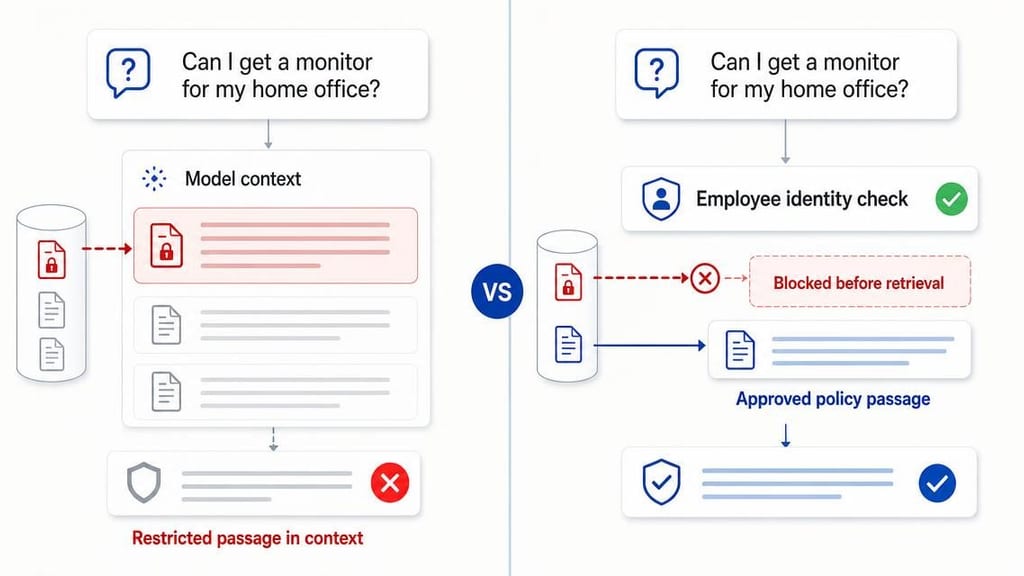
Permissions should be attached during ingestion and enforced during retrieval. The index should preserve document-level or passage-level access metadata from the source system. The search service must evaluate those rules against the authenticated user before returning content.
This also means a prototype built from exported files may be misleading. An export can remove the permission structure that production depends on.
Before indexing, map each source to an owner, identity system, access-group model, document identifier, and update signal. If those fields cannot be established, mark the source as unsuitable for the first release.
Revoked access must reach caches and conversations
Suppose the employee moves to a new team after asking about an equipment exception. A cache keyed only by question text can serve the old answer to another employee, and a saved conversation can carry the old passage into a new request. Both paths need an explicit policy.
Bind retrieval caches to the requester and a version of their authorization state, or revalidate cached evidence before use. Track document permission changes separately from content changes: a file can keep the same text while becoming restricted. Decide how quickly revocations must take effect and fail closed when the connector cannot establish current access.
For saved conversations, record which source documents supported each answer. Recheck access before reusing their passages in a later response. Previously displayed text cannot be made unseen, so retention and history visibility still matter; the goal is to prevent continued retrieval and reuse after permission changes.
Freshness is a content operation, not a model feature
RAG does not make a stale policy current. The system needs document owners, effective dates, review dates, replacement links, and a clear rule for superseded content.
When two documents disagree, the assistant should not quietly blend them. It should prefer the designated authority or disclose the conflict and escalate it.
When an employee follows a citation, the destination should perform its own access check. Avoid signing a document URL with a broadly privileged service account simply to make the link convenient. A citation that bypasses the original permission boundary defeats the purpose of safe retrieval.
Separate advice from action
An employee support assistant may explain how to request access. It should not grant access unless a separate, authorized workflow validates the requester, asset, approver, and policy conditions.
This boundary keeps the initial build focused on evidence-based support. If later phases add ticket creation or system actions, those capabilities need their own approval and audit controls.
Build path for a controlled pilot
A useful implementation starts with a short discovery phase. Interview support owners, sample recent tickets, inventory source systems, and map the identity groups that control access.
Next, create a content and permission register. Record each source's owner, authority level, update frequency, document identifiers, access rules, and escalation destination. This register becomes a release artifact, not a temporary spreadsheet.
Then build the smallest useful retrieval path:
- Connect one or two approved source systems.
- Preserve document structure and access metadata.
- Create a role-based test set from real employee questions.
- Add citations, refusal behavior, and escalation routes.
- Test restricted, ambiguous, stale, and conflicting content.
- Pilot with a defined employee group.
- Review outcomes with content owners before expanding scope.
Use separate test cases for answer quality and permission integrity. A system can retrieve the correct passage for an authorized user while still exposing that passage to the wrong role.
Test permission changes as well as static roles. Remove a user from an allowed group, repeat a previously successful question, and verify that the old passage is no longer retrieved. Then open the same conversation and check whether cached evidence or a regenerated answer can expose it again. Passing the first request does not prove that access stays correct over time.
Measuring value without trusting demo quality
A polished demo can answer ten prepared questions and still fail in daily use. Evaluation should use real employee wording, multiple roles, old document versions, ambiguous questions, and expected refusals.
Track an operating dashboard with five groups of measures:
- Retrieval quality: Did the system find the approved source and the correct passage?
- Answer support: Is each material claim supported by the retrieved evidence?
- Permission integrity: Did any test role retrieve content it should not see?
- Support outcome: Was the question resolved, escalated correctly, or reopened?
- Content health: How many failures came from missing, conflicting, or stale documentation?
For the pilot, compare results against the current support baseline. Useful measures include median time to an accepted answer, routine ticket volume, escalation accuracy, repeat-contact rate, and employee feedback after resolution.
Do not treat "thumbs up" as the only success measure. Employees may like a confident answer that is outdated. Source correctness and policy-owner review matter more.
Risks, limits, and when to wait
The largest risks are not limited to model wording. They include stale content, unauthorized retrieval, incomplete indexing, ambiguous authority, weak escalation, and over-reliance on a fluent answer.
Key limits include:
- Missing knowledge: RAG cannot retrieve a procedure that was never documented.
- Conflicting authority: Search ranking cannot resolve unclear policy ownership.
- Sensitive judgment: Employee relations, accommodations, investigations, and legal questions usually need qualified review.
- Permission complexity: Source systems with inconsistent access groups can make safe indexing expensive.
- Low question volume: A custom system may not justify its operating cost for a small, stable support queue.
- Poor structure: Scanned files, broken tables, and missing dates can reduce retrieval usefulness.
- Unclear accountability: No technical layer can substitute for an owner who approves the answer.
Wait when documents have no owners, policies change without version control, or identity data cannot reliably determine access. Fixing those foundations may create more value than adding a conversational layer.
What Quellix would build
For the monitor question, our enterprise AI search and RAG implementation would connect the equipment policy, approval table, and procurement procedure. Each source would have an owner, an effective version, an access rule, and an escalation destination.
We would test the same question as an employee, manager, contractor, and unauthorized user. The release would include citation checks, conflicting-policy handling, permission-change tests, and a support handoff that preserves permitted evidence. Missing access metadata would stop that source from entering the pilot.
The operating view would distinguish retrieval misses, unsupported claims, permission failures, and documentation gaps. That separation tells the team whether to repair a connector, rewrite a policy, or adjust answer behavior.
Bring a small set of real questions and the documents employees currently consult. We can then assess the current search path, connector limitations, and whether a contained assistant is worth maintaining.
Before the assistant answers everything
Keep the first release focused on one queue. Broader AI adoption and optimization consulting can help when source ownership, integration priorities, and escalation responsibilities need to be defined across teams.
Related Reading
- GPT-5.6 in Copilot Changes Permissioned Knowledge Work
- AI Agents: Workflows, Approvals, and Guardrails
- AI Agent vs Chatbot: Choosing the Right Build
FAQ
Can RAG use documents from several internal systems?
Yes, if each connector preserves ownership, version information, and access controls. The system should not flatten every source into one unrestricted index. Start with sources that expose reliable identity and permission data.
Should employee support RAG update HR or IT systems?
Not in the first phase unless the action has a clear authorization path. Begin with retrieval and guided escalation. Add system actions only after separate approval, validation, audit logging, and failure handling are defined.
How narrow should the first rollout be?
Choose one domain with repeated questions, reliable source material, named owners, and a measurable support baseline. A narrow production workflow provides better evidence than a broad company-wide demo.
How does permission-aware RAG prevent a sensitive answer from leaking?
It checks the requester's identity and permissions before restricted passages enter the retrieval result or model context. Final-answer filtering alone is not sufficient. Test the same question across representative roles, including users who should receive a refusal or escalation.
What happens when two internal policies conflict?
The assistant should not merge them into a confident answer. It should apply a documented authority rule when one exists. Otherwise, it should disclose the conflict, cite the relevant sources for an authorized reviewer, and route the case to the content owner.
What should a buyer provide for a technical review?
Provide one support queue, recent questions, representative source documents, permission-group information, ticket outcomes, and escalation contacts. Those materials help assess retrieval coverage, access feasibility, content health, and pilot measures before a larger build.